Tips
What to Wear for Professional Headshots
Most headshot outfit advice is fashion advice in disguise. This is the operational version: what actually shows up on camera, what to leave in the closet, and a note you can send your whole team before headshot day.
 Ben LoBue
Somewhere between the invite going out and the actual photo, almost everyone lands on the same question: what do I wear? It feels bigger than it is. A headshot only shows from roughly the chest up, so the decision is smaller than a full outfit, closer to a handful of choices about color, texture, and fit than a wardrobe overhaul.
The advice that actually helps is not a dress code. It is a short list of what photographs well and what fights the camera, adjusted for your industry and your own style. This guide covers that list, points you to the specifics for your field, and, because a lot of headshot day is now a company event rather than a solo shoot, gives you a note you can send your team before theirs.
What should you wear for a professional headshot?
A solid, mid-tone color that contrasts with your background, worn in a piece that actually fits: a blazer, a button-down, a fitted top. Skip busy patterns, logos, and anything shiny enough to catch the light. Beyond that, dress the way your industry and role expect, and keep your everyday glasses and jewelry if you normally wear them.

The colors that photograph well (and the ones that fight the camera)
Cameras do not read color the way your eyes do. A shirt that looks fine in the mirror can blow out under studio-bright light or vanish into a similar-toned background, and both problems are avoidable before you ever sit down for the photo.
Mid-tone, solid colors are the safest default: navy, burgundy, forest green, charcoal, plum. They hold detail under bright light and give the camera something to work with. Pure white can overexpose next to skin tones, and pure black can flatten into a shapeless block, especially on a darker background. Neither is off-limits, but both need more careful lighting than a mid-tone does, so they are a harder default to get right on your own.
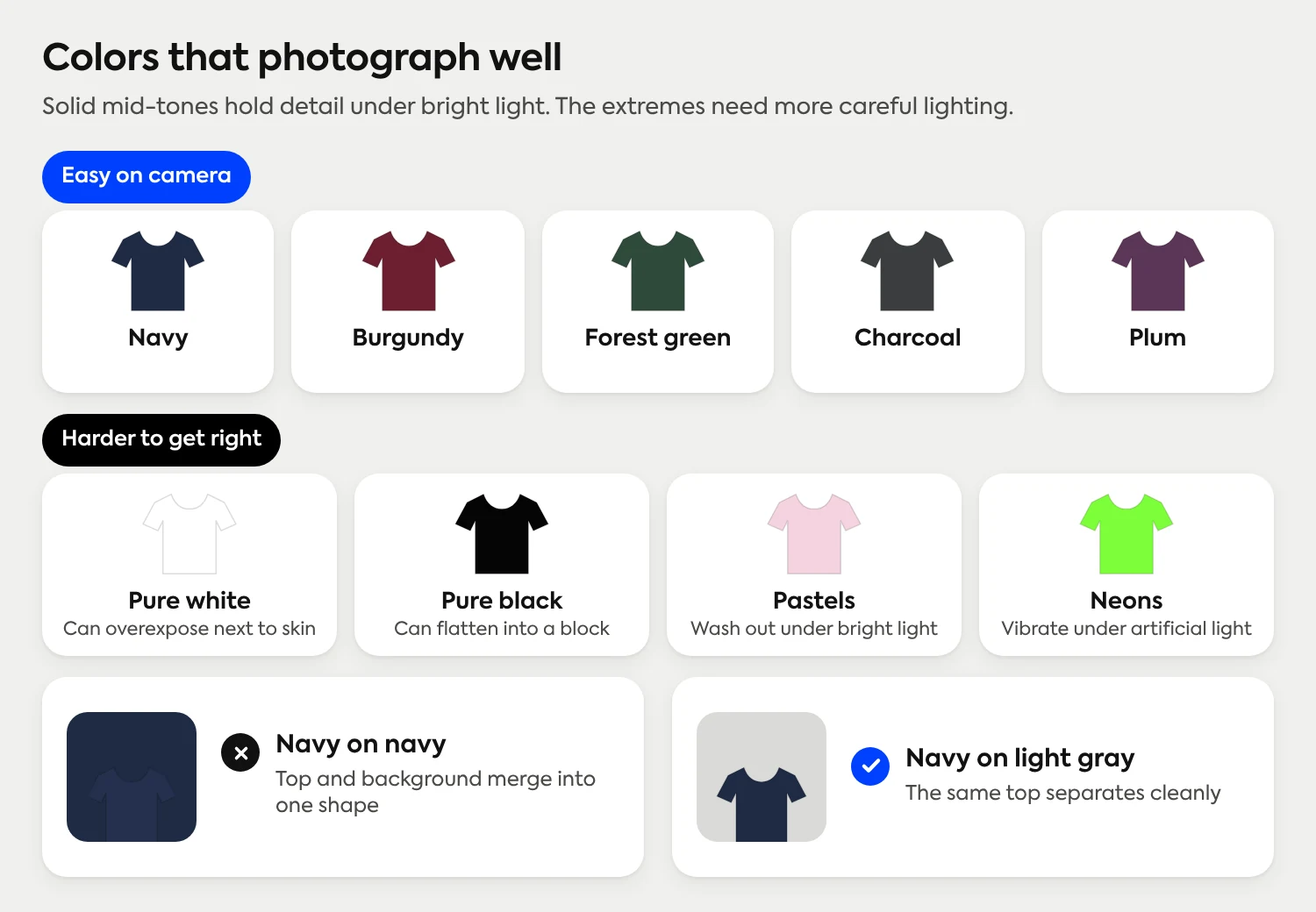
Pastels and neons tend to wash out or vibrate under artificial light, and they date a photo faster than a classic color does. The other variable worth thinking about deliberately is your background. A navy top against a navy backdrop reads as one shapeless mass; the same top against a light gray or warm-toned background separates cleanly. If you are choosing a background as well as an outfit, our guide to headshot backgrounds covers what actually photographs well behind you.
None of this is really about fashion. It is about what a camera sensor and a compression algorithm do with color, which is a narrower, more mechanical question than "what looks good."
Patterns, jewelry, and glasses: the details that actually show up on camera
Patterns. Fine stripes, houndstooth, and tight checks can create a shimmering, vibrating effect on camera called moire, which gets worse the smaller and more repetitive the pattern is. A solid color or a pattern with real scale to it (a wide stripe, a subtle texture) avoids the problem entirely. Save the busy tie or the bold print for a day when the photo is not doing the deciding.
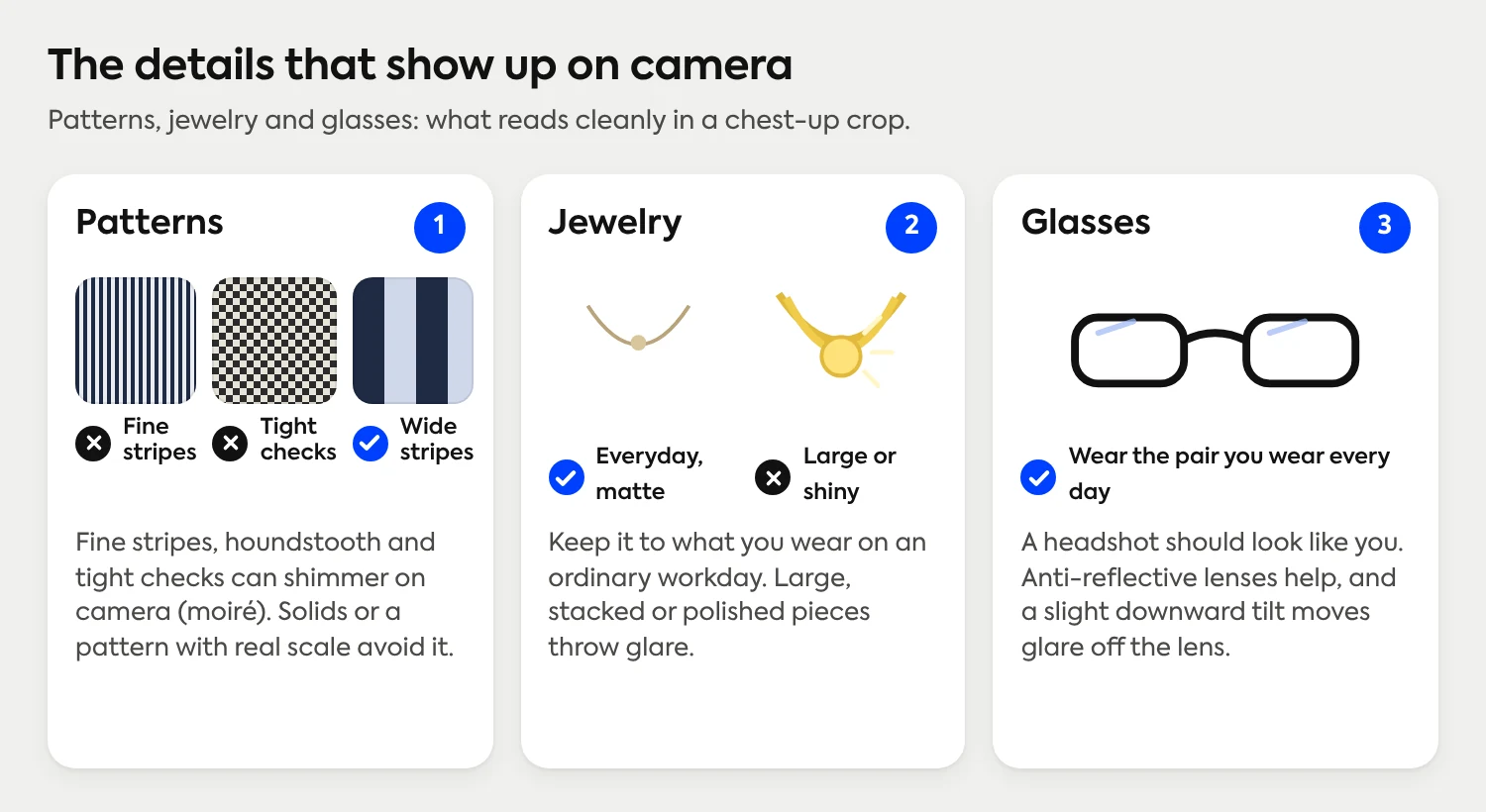
Jewelry. Keep it close to what you wear on an ordinary workday. Simple, non-reflective pieces read as put-together; anything large, stacked, or highly polished can throw a hot spot of glare directly under a light. If you are not sure, less is the safer call, since a headshot rarely benefits from an accessory doing a lot of visual work.
Glasses. Wear them if you wear them day to day. A headshot that does not look like you defeats the purpose, and people who know you will notice the omission faster than they will notice a glare spot. Anti-reflective lens coating helps if you have it, and tilting the frames very slightly down can angle a light source away from the lens if a preview shows glare. A guided capture flow with a live preview, the way Scale's Studio 2 works, lets you spot glare before you submit instead of after.
Fit matters more than formality
A well-fitted button-down photographs better than an expensive blazer that pulls at the shoulders. Fit is the variable that reads as "professional" from across a room or a browser tab, more than the formality level of the piece itself.
A few fit rules hold up across almost every style: long or three-quarter sleeves photograph more polished than short sleeves in most professional contexts, and a second layer, a blazer or a structured cardigan, adds shape and gives the eye something besides a flat block of color. Necklines that sit modest and close to the collarbone tend to photograph cleaner than deep V-necks or off-the-shoulder cuts, mostly because they keep the frame focused on your face instead of competing with skin and fabric lines lower in the shot.
Whatever you choose, steam or iron it the night before. A stiff, fresh-from-the-package shirt holds visible fold lines on camera in a way it never does in person, and a wrinkle at chest height in a chest-up crop is impossible to miss.
What to leave in the closet
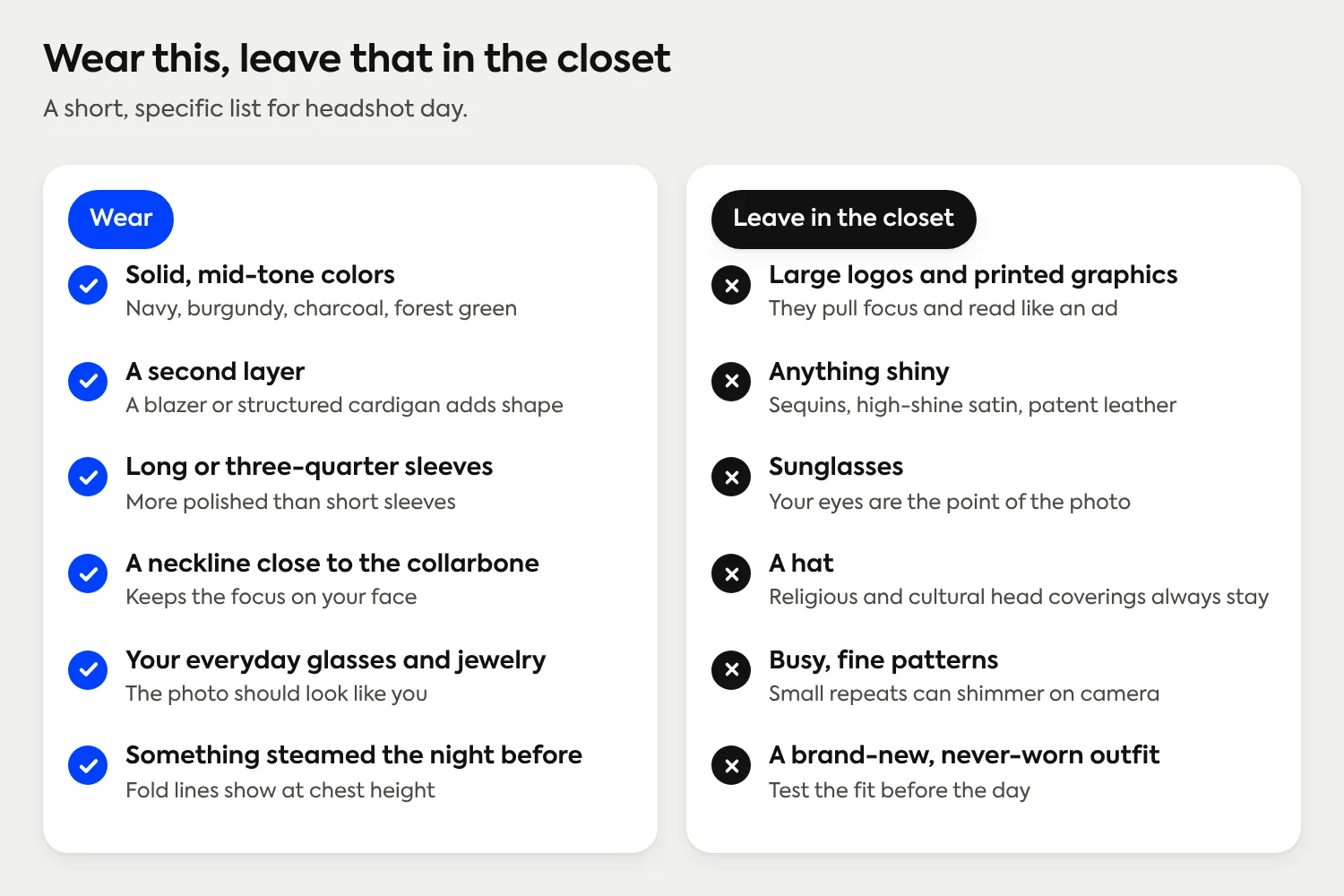
A short, specific list beats a vague one. Skip large logos and printed graphics, which pull focus and can read as an ad rather than a portrait. Skip anything shiny enough to catch a light source: sequins, high-shine satin, patent leather visible in frame, all of which can blow out into a small, distracting hot spot. Skip sunglasses, obviously, and skip a hat unless it is a religious or cultural head covering, which is never something to leave out. And skip the brand-new outfit you have never actually worn: a headshot day is the wrong time to find out a collar gaps or a jacket pulls when you raise your arm.
One more: skip the idea that there is a single right answer here. A startup engineer in a well-fitted henley and a litigation partner in a tailored suit can both have an excellent professional headshot, because "professional" describes how the photo is composed and lit, not a specific garment.
Do headshot attire guidelines differ by role or personal style?
The principles above apply the same way regardless of who is wearing the clothes: solid colors, good fit, minimal pattern, your actual glasses and jewelry. What changes is not a rule set split by who you are, it is the specific pieces that fit your role, your industry, and your own style, the same way a dress code flexes for a law firm partner and a creative director without being two different sets of instructions. Pick from the color and fit guidance above, then lean on the industry norms below or your own read of your workplace.
What to wear, by industry
The general answer above gets you most of the way. The rest is context: a look that reads as polished at a law firm can read as stiff at a design studio, and the reverse is just as true. Our use-case guides break down attire, backgrounds, and expression by field, each with example photos by field.

Lawyers and attorneys. Attire runs from Big Law formal to boutique-practice relaxed, and the register should match the setting, not just the title. See the guide to lawyer and attorney headshots.
Executives and CEOs. Boardroom-formal, modern-CEO, and founder registers each send a different signal before anyone reads a word of copy. See the guide to executive and CEO headshots.
Realtors and agents. Luxury, suburban, and commercial markets each carry their own unwritten dress code, and it is worth matching. See the guide to realtor headshots.
Medical and clinical staff. The white coat is standard for physicians, but residency applicants, nurses, and admin staff each have a different expected look. See the guide to medical headshots.
LinkedIn specifically. LinkedIn photos are seen small and often cropped tighter than other formats, so pattern and color choices matter even more there. See the guide to LinkedIn headshots.
Creative and modern brands. Editorial, brand-forward, and studio-polished registers all read as "creative professional" without looking interchangeable. See the guide to creative and modern headshots.
Casual and startup teams. Casual does not mean careless. Smart casual and brand-forward casual both photograph as intentional, not thrown-together. See the guide to casual headshots.
Outdoor and on-location shoots. An outdoor setting changes what colors and textures hold up against natural light and greenery. See the guide to outdoor headshots.
Finance and banking. A conservative field with real room for individual register within that conservatism. See the guide to finance and banking headshots.
Nonprofit and association staff. Approachable and credible without reading as corporate. See the guide to nonprofit and association headshots.
What to tell your team before headshot day
If you are the one organizing headshots for a team rather than sitting for your own, the hard part is rarely the photography. It is getting fifteen or two hundred people to show up dressed in a way that reads as one set instead of fifteen or two hundred separate decisions. A short note before the day, sent once, solves most of it.
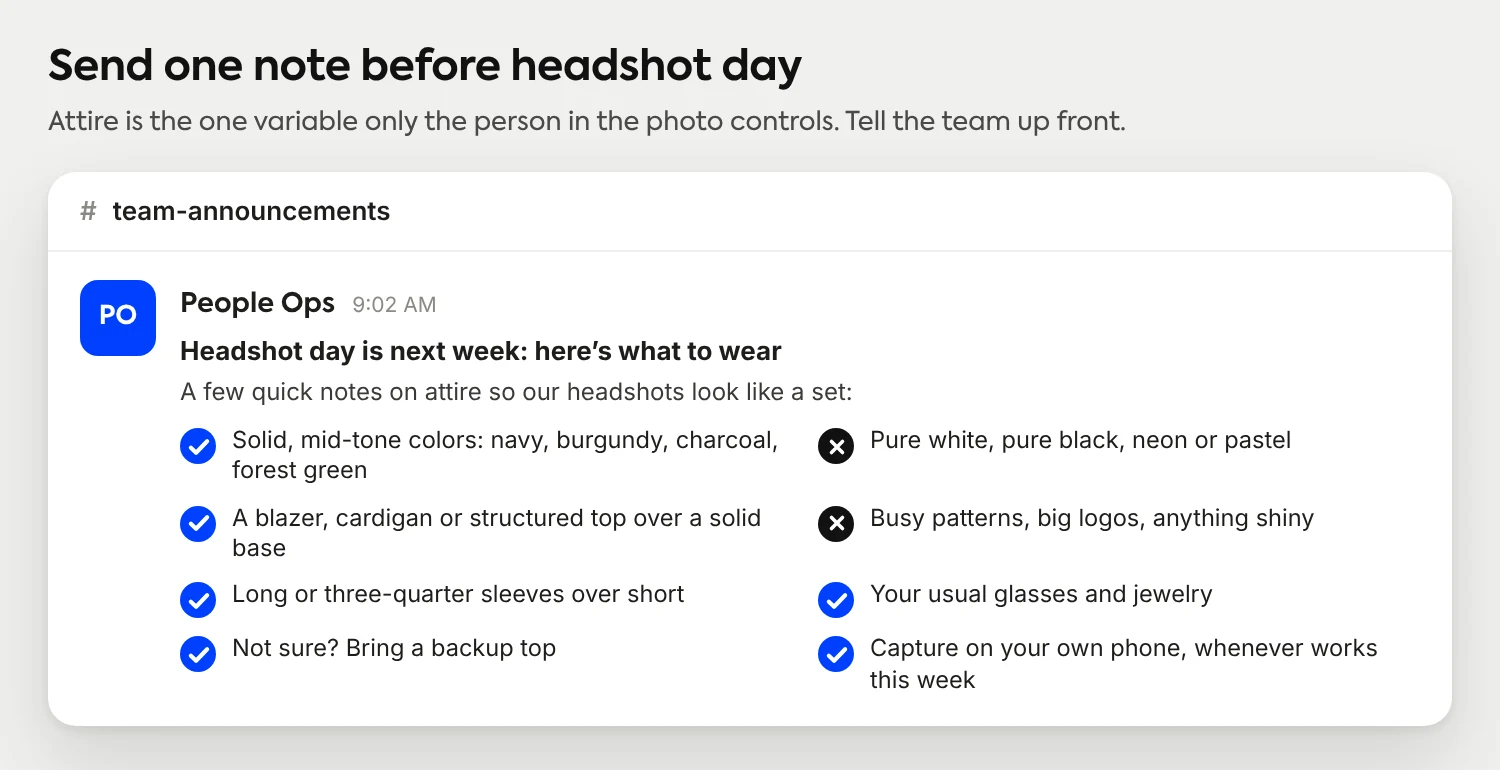
Copy this into a Slack message or email before headshot day
Subject: Headshot day is [date], here's what to wear
A few quick notes on attire so our headshots look like a set:
Solid, mid-tone colors work best (navy, burgundy, charcoal, forest green). Skip pure white, pure black, and anything neon or pastel.
Skip busy patterns, big logos, and anything shiny (sequins, satin, patent leather).
Wear your usual glasses and jewelry. No need to change how you normally look.
A blazer, cardigan, or structured top over a solid base photographs best. Long or three-quarter sleeves over short.
Not sure? Bring a backup top. It takes ten seconds to swap before you capture.
Capture through [the link/platform], on your own phone, whenever works for you this week.
Send it with the invite, not after the first few photos come back inconsistent. Every other part of headshot day (background, lighting, framing) can be held constant by the platform. Attire is the one variable that only the person getting photographed controls, so it is the one that needs a note in advance.
Where attire fits into what Scale actually does
Worth saying plainly: Scale is AI edited, not generated. Your team member wears their own clothes and captures a real photo of themselves, on their own phone, through a guided flow that gives live feedback before they submit. Scale's AI edits the photo afterward: background, lighting, color balance, framing, and upscaling. It does not touch the person and it does not touch what they are wearing. It will not swap a busy pattern for a solid one, and it will not turn a t-shirt into a blazer.
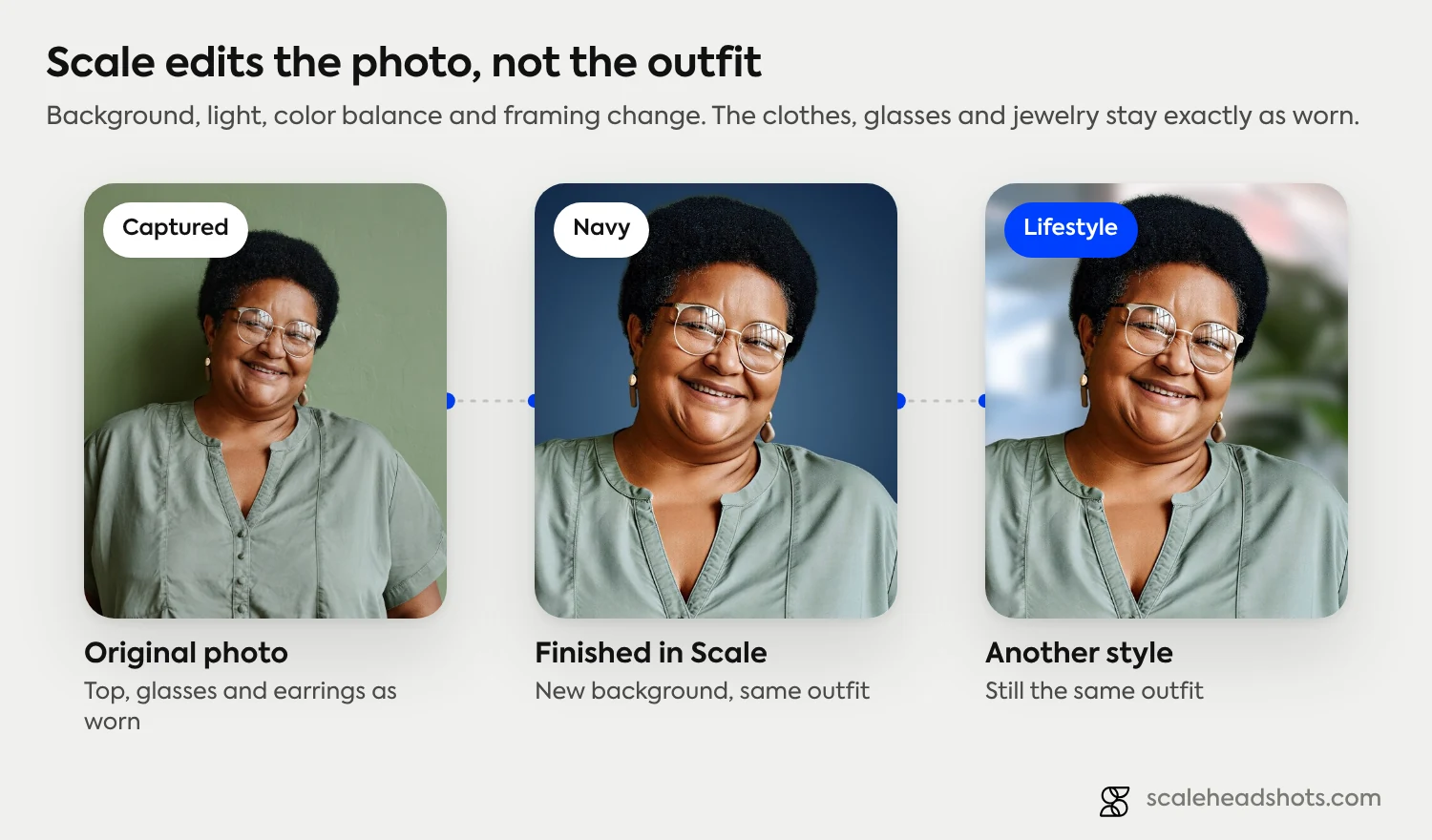
That is exactly why the guidance above still matters. The platform can give everyone the same clean background and the same balanced light, and Studio 2's guided capture gives live framing and lighting feedback, with up to four retakes per submission to fix glare on glasses or a rumpled collar. None of it corrects for an outfit choice that does not photograph well in the first place. Attire is still the one variable that belongs entirely to the person in the photo.
Credits start at $25 per headshot and never expire, with three free credits to try the flow before anyone commits a budget. No subscriptions, and volume pricing brings the per-person cost down as a team grows. See the full breakdown on pricing or read about the makeup side of headshot prep in our do's and don'ts guide.
Frequently Asked Questions
What colors are best for a professional headshot?
Solid, mid-tone colors like navy, burgundy, charcoal, and forest green photograph most reliably. They hold detail under bright light and contrast cleanly against most backgrounds. Pure white, pure black, pastels, and neons are harder to get right and are worth avoiding unless you know your lighting setup well.
Can you wear patterns in a professional headshot?
Large-scale, low-contrast patterns are usually fine, but fine stripes, houndstooth, and tight checks can create a shimmering moire effect on camera. When in doubt, a solid color is the safer choice, since it never fights the camera the way a busy pattern can.
Should you wear glasses in a headshot?
Yes, wear your everyday glasses if you normally wear them. A headshot that does not match how you actually look defeats its own purpose. Anti-reflective lens coating helps reduce glare, and a slight downward tilt of the frames can angle a light source away from the lens if a preview shows a hot spot.
What jewelry works for a professional headshot?
Simple, non-reflective pieces close to what you would wear on a normal workday. Large, stacked, or highly polished jewelry can catch a light source and create glare, so less tends to photograph better than more.
What should you wear for a LinkedIn headshot specifically?
The same general guidance applies, with one wrinkle: LinkedIn photos are often viewed small and cropped tighter than other formats, so busy patterns and low-contrast colors matter even more there. A solid, mid-tone color with a clean, uncluttered background reads clearly even at thumbnail size.
What should you not wear for a professional headshot?
Skip large logos, busy graphic prints, anything shiny like sequins or patent leather, and sunglasses. Avoid brand-new, never-worn clothing, since fresh fold lines show clearly on camera. Hats are generally out, except for religious or cultural head coverings, which are never something to leave off.
Do men and women need different headshot attire?
No, the underlying principles are the same for everyone: solid mid-tone colors, good fit, minimal pattern, and your own glasses and jewelry if you wear them. What differs is the specific pieces that suit your role, industry, and personal style, not a separate rule set based on who is wearing the clothes.
Does headshot attire really change by industry?
Yes, meaningfully. A look that reads as sharp at a law firm can read as stiff at a creative agency, and a casual outfit that fits a startup can undersell a finance role. The general color and fit rules hold everywhere; the specific register (formal, business casual, creative, clinical) is worth matching to your field. See the industry guides above for real examples.
Still have questions? Get in touch and we'll be happy to help!
Dress for the photo, Scale handles the rest
Your team wears their own clothes and captures a real photo on their own phone. Scale's AI edits the photo (background, lighting, color, framing), never the person and never the outfit. Real photos, AI edited, not generated. Credits start at $25 and never expire, and you can try it with three free credits.