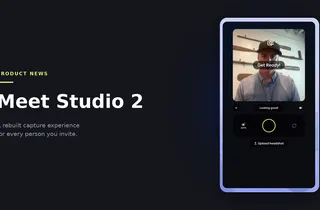
Style Guide
Guide to Creative & Modern Headshots
Modern team headshots show up everywhere a customer, candidate, or partner is forming an opinion of the brand. The About page, the Instagram grid, the sales deck, the conference speaker card. A dated or off-brand headshot makes the whole brand feel a step behind, so we wrote this guide to help modern teams plan, capture, and manage on-brand portraits across the full team. The modern, seamless way.
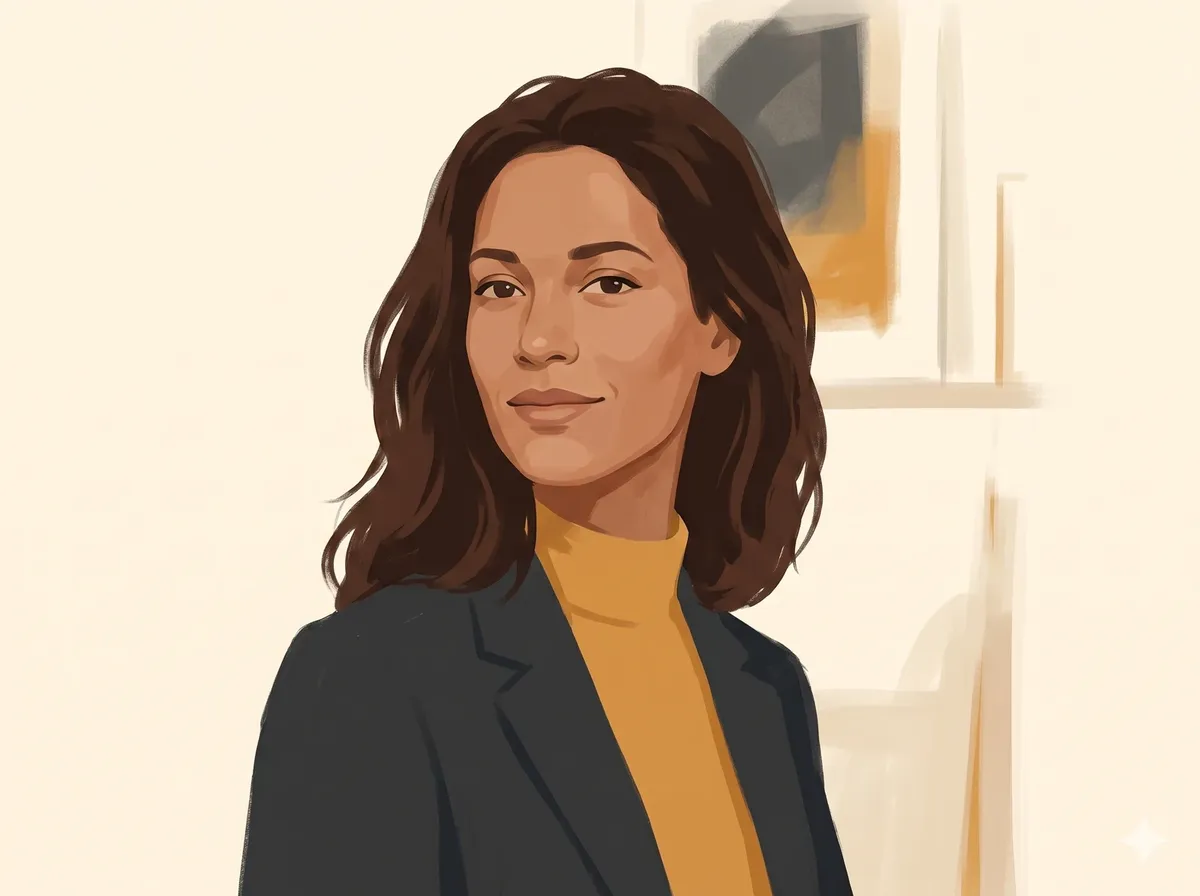
Why Modern Headshots Matter for Modern Brands
For a brand that has invested in a modern visual identity, the team page is the moment where that identity gets tested. A customer who's just spent ninety seconds on a beautifully designed homepage clicks About and lands on twelve headshots taken in twelve different rooms, on twelve different days, by twelve different cameras. The brand they thought they were buying suddenly looks like a much smaller, much less coordinated operation.
The team page does brand work whether you intended it to or not. Visitors don't separate the headshots from the rest of the site. They assume what's on the team page is what the brand allows, and by extension endorses. When a creative agency's team grid shows polished editorial portraits with cohesive backgrounds, the agency reads as the operation it claims to be. When the same grid shows a mix of LinkedIn shots, conference badge crops, and that one portrait taken in someone's kitchen during the pandemic, the brand quietly contradicts itself.
This matters most during trigger moments. A brand refresh or full website relaunch where every team photo gets re-evaluated against the new visual system. A Series B announcement where the leadership team headshots land on TechCrunch the same morning. An agency repositioning where the new vertical focus needs a team page that reflects it. A new-hire wave from a recruiting class or acquisition where ten new portraits need to drop in without breaking the existing aesthetic. Each one creates a window where the team's headshots suddenly need to be current, on-brand, and platform-correct at the same time.
The surfaces keep multiplying. Beyond the brand site, modern teams need current portraits for LinkedIn, Twitter / X, the company Instagram and the personal one. About pages, leadership announcements, sales decks. Conference speaker cards, podcast guest tiles, byline avatars, press kits. The Slack and Gmail avatars teammates see all day. One person's outdated portrait can pull on every thread the brand team has spent months weaving together.
The challenge isn't whether modern teams need professional headshots. It's how to get them done with a look that feels current, on-brand, and unmistakably yours, without flying a photographer to every office and chasing down ten people for a month. And ideally with the flexibility to render up to 5 versions per person from a single capture, so a polished primary portrait, a brand-forward alt, and a few specialty variants can live side by side, no second shoot required.

Who This Guide Helps
Creative Agencies
Design, brand, advertising, and marketing agencies whose team page is part of the portfolio. Headshots are creative work product, not back-office admin.
Tech Startups & Scale-Ups
Seed through Series C teams where the modern-look table stakes and About-page cohesion signal credibility to candidates, customers, and investors.
In-House Brand & Marketing Teams
Brand, comms, content, and design teams at modern B2B and B2C companies. The team page must match the brand system the rest of the site is built on.
Media, Production & Lifestyle Brands
Editorial teams, production companies, lifestyle and consumer brands where visual style is identity. Polished, but never corporate.
What Creative & Modern Headshots Look Like
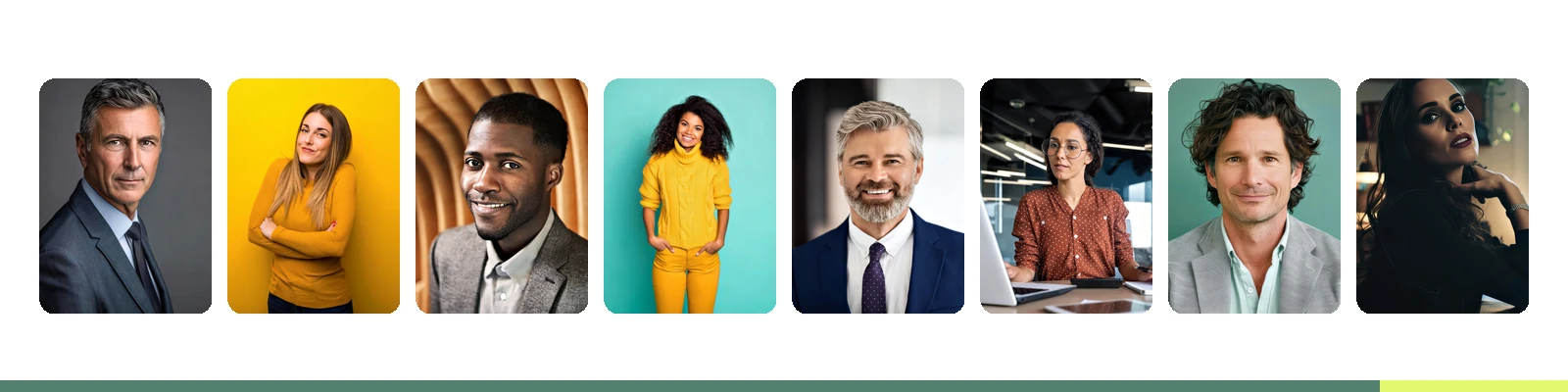
Modern team headshots share a handful of common traits, even when the visual styles vary widely. They feel current and considered, with the 2014 stock-photo template firmly in the past. The lighting feels closer to a window than a floodlight, and the expressions land closer to candid than performed. Backgrounds fit the brand, whether that's a charcoal cyclorama, a swatch of brand color, or a thoughtfully chosen corner of the workspace. And across the team, the individual portraits read as one operation while still letting personality through.
Within that, modern brands typically pick from one of four style modes. None is more correct than the others; the right pick depends on the brand voice, the team's role, and where the portraits will live.
The Modern Style Spectrum

Editorial Modern
Clean, magazine-feature aesthetic. Soft natural light, neutral or charcoal background, refined wardrobe, confident composure. Reads as established and considered. Common for leadership pages, agency principals, and press kits.
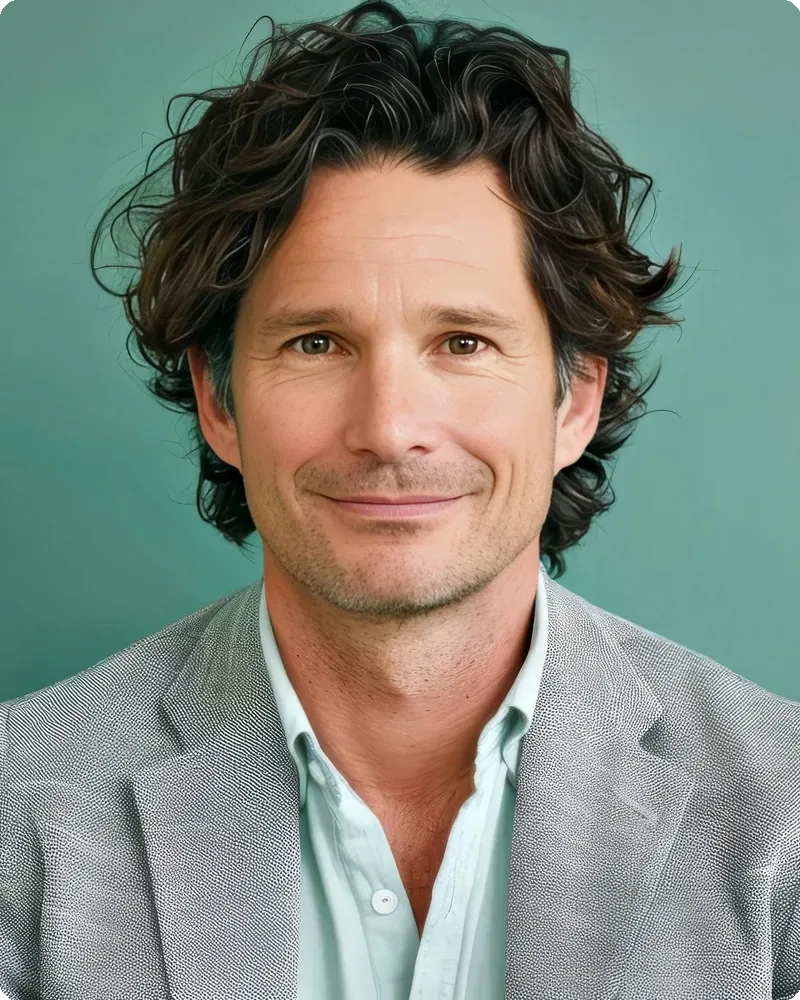
Brand-Forward
The brand's color system shows up in the portrait. Background pulled from the brand palette, wardrobe selected to complement, lighting tuned to the visual identity. Reads as design-led and intentional. Common for creative agencies and design-forward brands.
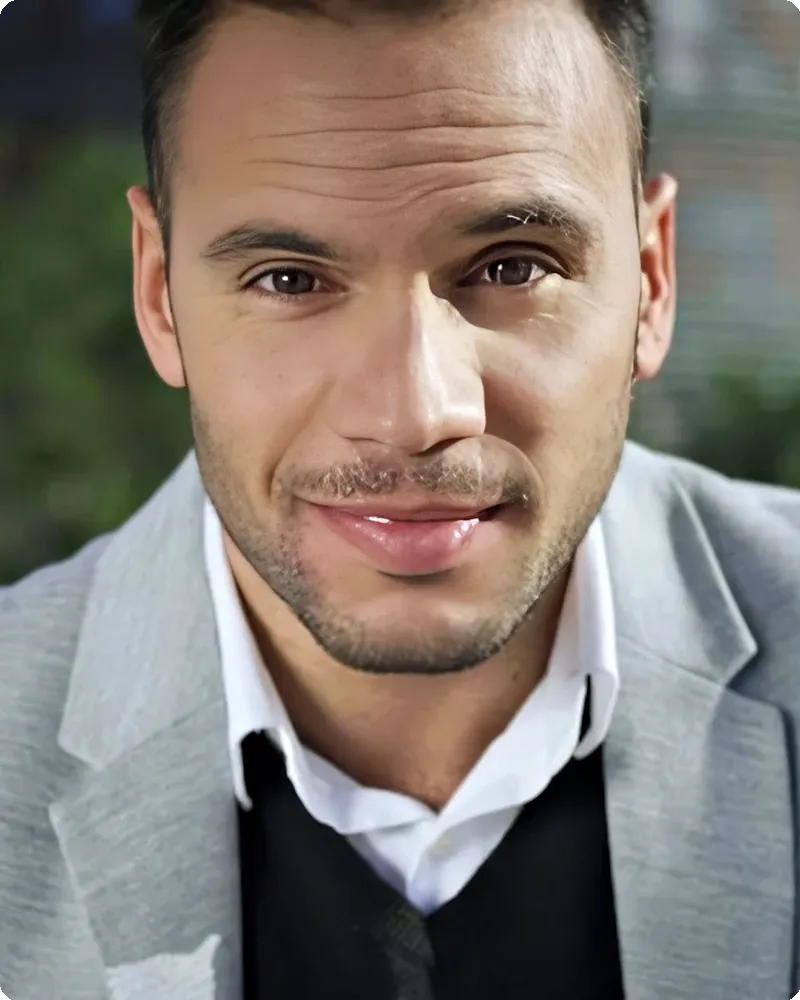
Studio Polished
Modernized take on the classic studio portrait. Clean background, controlled lighting, but warmer expression and softer styling than the corporate default. Reads as polished without feeling stiff. Common for tech, professional services going modern, and growth-stage startups.

Environmental Documentary
Captured in the team's actual workspace, with natural environmental detail intentionally in frame. Reads as authentic and lived-in. Strong for production companies, hospitality, and brands whose space is part of the story.
What's Modern in 2026
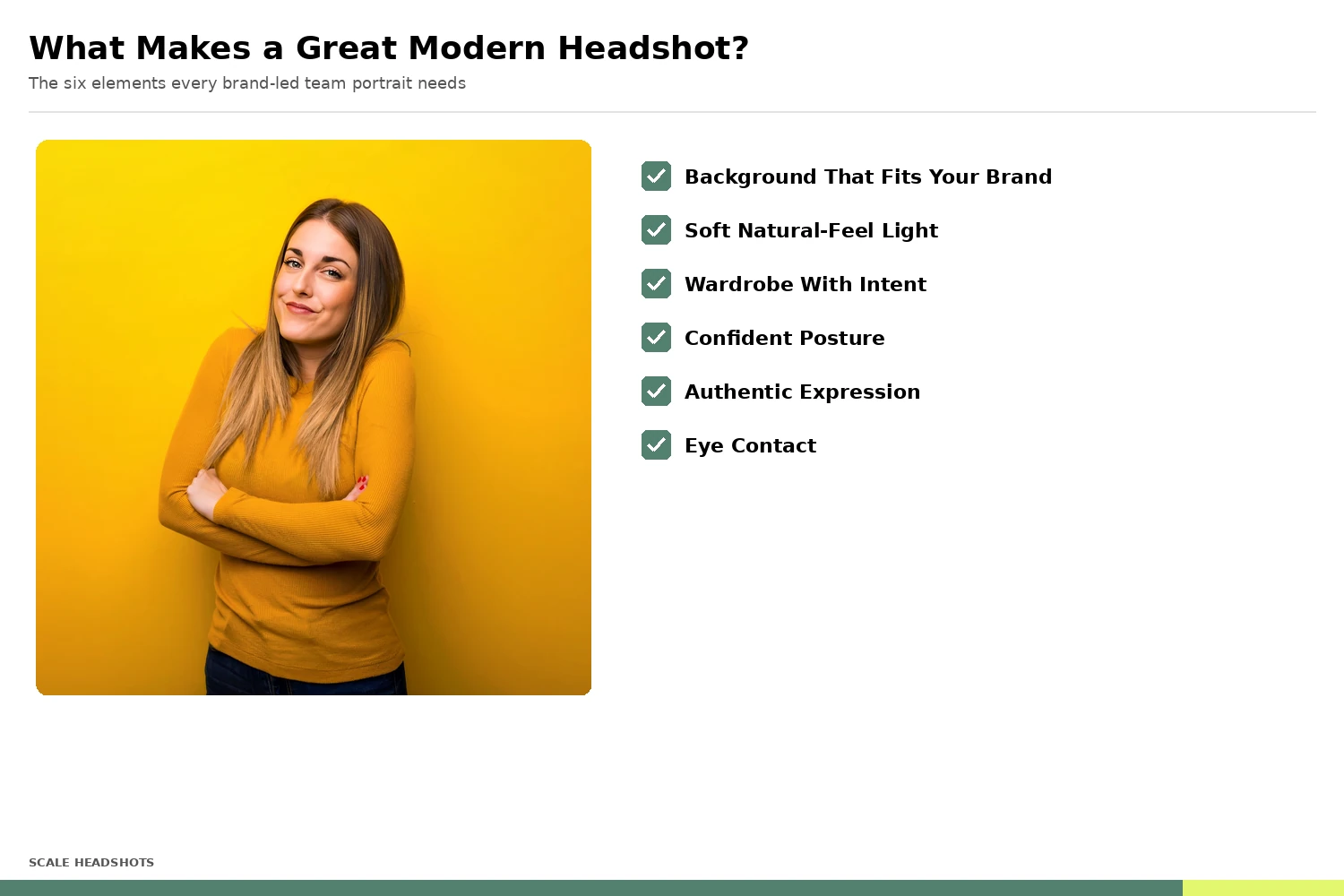
The 2026 modern headshot has moved away from the floodlit, heavily retouched studio portrait. Soft natural-feel light, charcoal or jewel-tone backgrounds, mid-tone wardrobe (navy, burgundy, emerald, charcoal, cream), a body angled around 30 degrees with the face turned back to the lens, and minimal post-processing that preserves real skin texture. Authenticity reads as more credible than polish.
See modern headshot examplesUniversal Standards
A few rules hold across every modern style mode.
Wardrobe should match the role the portrait plays. Editorial and brand-forward looks reward intentional choice: a single statement piece, a brand-aligned color, a texture that adds dimension at small thumbnail sizes. Studio-polished and environmental looks reward simplicity: solid mid-tones in navy, burgundy, emerald, charcoal, or cream photograph cleanly across every placement. Avoid busy patterns, large logos, and statement jewelry that competes with the face.
Expression should land closer to a relaxed, in-conversation moment than a smile-for-the-camera pose. The teeth-showing smile reads warmer and more trustworthy than the closed-mouth corporate version, but an exaggerated grin reads as performed. The best modern portraits are usually captured 30 seconds in, after the subject stops thinking about being photographed.
Backgrounds should be consistent across the team, even if the style mode varies by individual. Pick one background style for the leadership grid, one for the broader team, and apply it without exception. Modern teams use charcoal or near-black backgrounds when the goal is editorial gravitas, soft neutral when the goal is openness, and on-brand color when the team wants the portrait itself to be a brand cue.
Framing is mid-chest up, with a small bit of room above the head. Profile thumbnails on LinkedIn, the brand site, and conference speaker cards crop differently on every platform. Leave room for the crops; you can always tighten later, but you cannot recover pixels.
The single biggest quality issue modern brands face isn't any one person's portrait. It's the team page that reads as twelve different sessions instead of one coherent identity.
See Real Examples
Browse 180+ real team headshots by industry, or compare 20 before-and-after enhancements.
The Brand-Cohesion-Without-Looking-Corporate Problem
Ask any brand lead, marketing director, or agency principal about updating the team's headshots and you'll hear a version of the same story. The team is too distributed, too busy, and too stylistically opinionated to push through a one-size-fits-all photographer day, but every alternative breaks brand cohesion in a different way.
The traditional brand-day shoot solves consistency by removing variation entirely. Everyone shows up at the same studio, on the same day, in front of the same lights and the same backdrop. The team page comes out matching, but it also comes out feeling stamped. Personality gets coached out. The creative director and the operations lead end up looking like they're working at the same insurance company, even when the rest of the brand is anything but. And the day itself misses the people who were on a client trip, on parental leave, or just hired the week before. Those portraits get rescheduled, miss the makeup day, and quietly default to LinkedIn shots a year later.
The alternative, asking everyone to capture their own and just send something in, fails the other direction. Variety arrives in spades. Cohesion does not. The team page becomes a patchwork of phone selfies, vacation crops, badge photos, and the one person who happened to have a recent professional shoot. The agency or brand ends up looking less coordinated than its website promises.
Traditional photography also doesn't bend with the brand's pace. A rebrand pushes a re-shoot. A new hire pushes a re-shoot. A leadership change pushes a re-shoot. Every refresh resets the budget and the calendar. For a startup pushing through a Series B, a creative agency in the middle of a repositioning, or a brand team launching a new identity, the headshot logistics become the slowest part of the brand work.
What modern teams actually need is a path that holds the line on consistency at the system level (background, framing, brand-aligned style) while leaving room for personality to come through inside that frame. Even better if the same capture can render up to 5 versions at once. A polished primary portrait for press, sales decks, and the leadership grid. A creative or brand-forward alt for the About-page hover state. A studio-polished version for the company directory. An environmental version for case-study bylines. One capture, every variant the brand needs, all from a single credit per person.
How to Capture Modern Headshots Without a Studio
You don't need a $5,000 brand-day shoot to land team portraits that read as modern. Today's smartphone cameras produce results that hold up at every web placement when paired with a few fundamentals. For modern teams, the trick is removing as much friction as possible so each capture takes 15 minutes, on the team member's own schedule, wherever they happen to be.
1. Lighting
Natural light from a large window is ideal. Position the subject facing the window (not with the window behind them) so light falls evenly across their face. Avoid direct overhead lighting, which carves harsh shadows under the eyes and reads as fatigue. Mid-morning or late afternoon light is softest. Most modern offices have at least one window that works, and team members capturing from home will find similar light in any room with a south- or east-facing window. The 2026 modern look leans into this soft natural-feel light. It's the single most effective swap from the older floodlit-studio aesthetic.
2. Background
Keep it clean and intentional. A plain wall in the office or at home works for studio-polished or editorial styles. For brand-forward or environmental modes, a swatch of brand color or a thoughtfully chosen on-brand corner of the workspace can carry meaning. The principle: every team member should use the same background style, even if the exact wall changes. Or rely on a platform that replaces the background to match a single brand standard.
3. Camera Position
Eye level or slightly above. A phone mounted on a small tripod at about five feet high gives the most natural perspective. Avoid shooting from below (unflattering and dated) or too far above (diminishing).
4. Framing
Mid-chest up, with some space above the head. Don't crop too tightly; LinkedIn, brand-site avatars, and speaker cards all crop to different ratios. Leave room for the crops. You can always tighten later. You can't recover pixels.
5. Coaching and Posing
Position the subject at a slight angle to the camera (around 30 degrees) with the head turned back toward the lens. Direct head-on framing reads as a passport photo. Fully turned reads as a magazine sidebar. The slight angle reads as natural and confident. Have them drop their shoulders, push the chin slightly forward and down to avoid double-chin compression, and take a breath before each shot. Coach for an expression that lands closer to a relaxed in-conversation moment than a smile-for-the-camera pose. Have them think of something specific (a recent project win, the team they actually like working with, a piece of work they're proud of) so the eyes carry warmth. Take several shots in quick succession. The best portrait is usually captured 30 seconds in, after the subject stops performing.
These basics work whether the team member is in the office, at home, or between meetings. The key is providing the same simple guidance to every person and applying it on whatever schedule works for each individual.
Set Up Your Studio in 10 Minutes
Admins customize the branding, headshot styles, and send invites to the team. Every team member captures on their own schedule. Scale handles the rest.
Where Modern Team Portraits Show Up
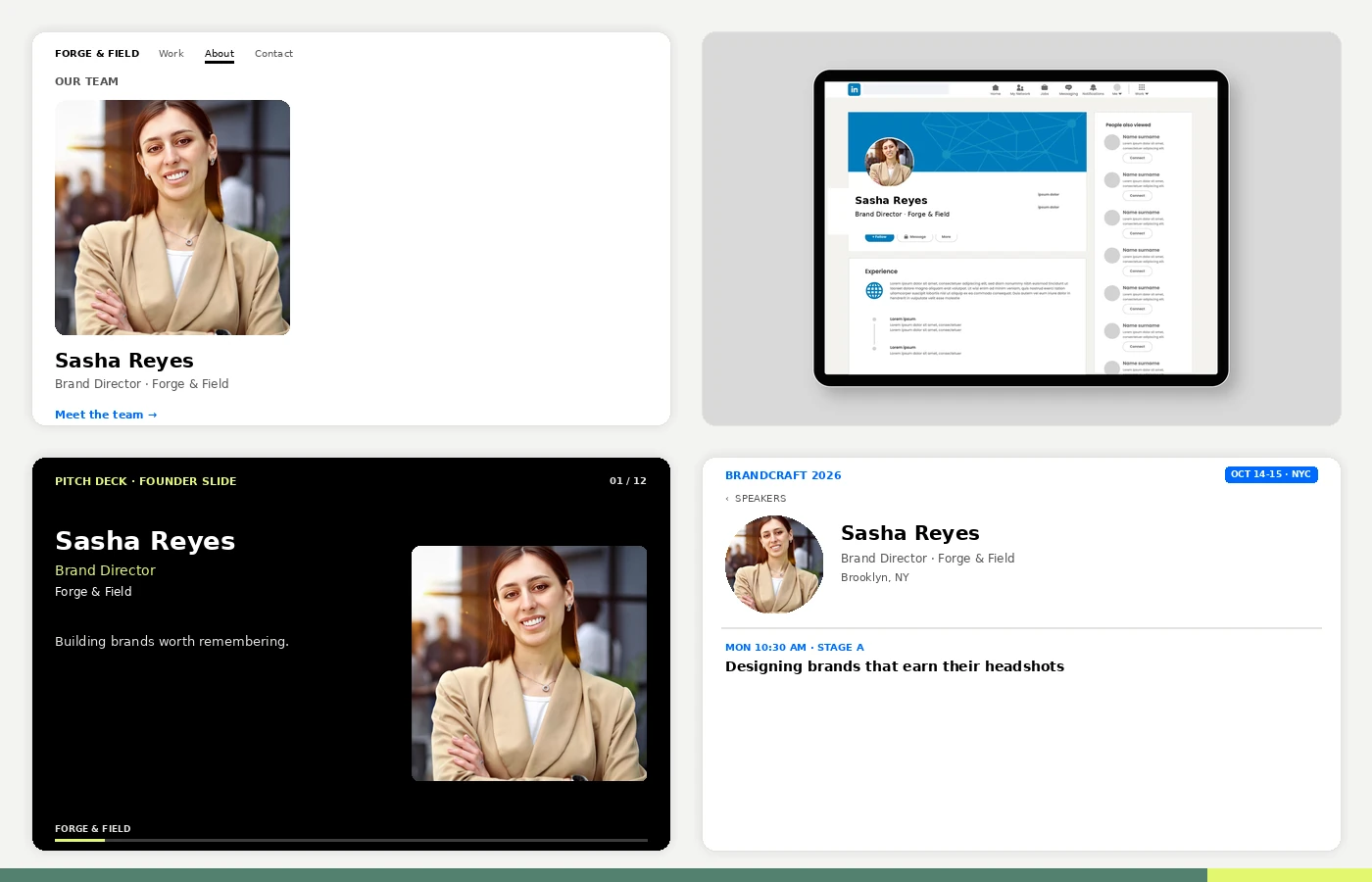
Brand Site & About Pages
The team grid, leadership page, founder bio. The first impression of the people behind the brand.
LinkedIn & Social Profiles
Personal LinkedIn, the company page, Instagram bio, X / Twitter avatar. The portrait the audience sees daily.
Sales Decks & Pitches
Founder slide, team slide, agency capabilities deck, pitch competitions. Investor and client-facing.
Conference & Speaker Cards
Event speaker pages, panel announcements, sponsor cards, podcast guest tiles. Press-quality required.
Press, PR & Bylines
Press kits, leadership announcements, contributed articles, byline avatars. Photo-quality scrutiny applies.
Internal Tools & Avatars
Slack, Gmail, Notion, the company directory. The portrait teammates see all day, every day.
Each surface benefits from one photo, every format. A single high-quality source portrait formatted for every placement, without redoing the capture every time the brand evolves or someone changes their bio. That's the modern team's actual headshot workflow once the platform replaces the photographer.
Why Scale
The Scale Advantage for Modern Teams
| Scale Headshots | Traditional Photography | |
|---|---|---|
| Cost per person | Starting at $25 | $200-$1,500+ (style and metro dependent) |
| Scheduling | None. Team members self-serve on their own time | Coordinate calendars across the team |
| Distributed teams | Works anywhere with a phone and decent light | Multiple sessions or travel coordination |
| New hires | Send an invite link | Rebook the photographer |
| Brand refresh | Update the studio settings and re-render | Re-shoot the entire team |
| Output styles per capture | Up to 5 style variants from the same photo, all included in 1 credit per person | Single look from the session |
| Quality control | Admin review dashboard with retake requests | One pass, then it's printed |
 Scale Headshots
Get Your Design Team Back on the Brand Work
The real cost of team headshots isn't the photographer line item. It's your design team's hours capturing, retouching, formatting for every placement, and redoing it the next time the brand evolves. Scale handles all of it: up to 5 style outputs per person, every format the team uses, ongoing refreshes without rebooking. Free up your designers for the brand work that actually moves the needle.
How Scale Headshots Works for Modern Teams
Scale Headshots is the self-service company headshots platform built for exactly this situation: brands and agencies that need professional, on-brand portraits across a team, from 5 people to 50,000+, without the logistics of traditional photography. The platform's defining feature for creative and modern teams is multi-output per capture. The admin configures up to 5 style modes per studio, and every team member's single capture renders into all of them at the same time, for a single credit per person. The leadership team can have an Editorial Modern primary, a Brand-Forward alt, a Studio Polished version for the directory, an Environmental Documentary version for the case-study byline, and a fifth specialty variant. All from one photo. All for one credit.
Here's how it works for a modern brand or agency.
1. Set Up Your Studio
An admin (brand lead, marketing director, or operations lead) creates the brand's studio, customizes the visual identity, and configures the style modes the team will use, in about ten minutes. The platform is free to set up; you only pay for approved portraits.
2. Set Up Multi-Output Style Modes
This is the platform feature that resolves the consistency-versus-creativity tension. The admin configures up to 5 style modes per studio (any combination of Editorial Modern, Brand-Forward, Studio Polished, Environmental Documentary, or other custom modes), and every team member's single capture renders into all of them automatically. One capture, every selected variant, one credit per person. The leadership grid can run an Editorial Modern primary plus a Brand-Forward alt, both produced from the same photo, both ready for the About-page hover-state pattern that modern brands love. Different groups inside the same studio can also default to different style sets. Configure once, assign team members to the right group, and Scale renders every requested style from each capture automatically.
3. Invite Your Team
Each person receives a link to capture their portrait. They use their phone or laptop camera, following guided instructions for positioning, lighting, and framing. No app download required. Capture happens at the office, at home, or between meetings, on the team member's schedule.
4. AI Enhances the Real Photo
Scale doesn't generate a synthetic image. It takes the actual photo the team member captured and enhances it: correcting lighting, removing the background, applying the assigned style, and upscaling quality. The result is a real photo of a real person, polished to the brand standard. This matters for modern teams where authenticity reads as more credible than polish. The customer who meets the founder at a conference should see the same person they saw on the website.
5. Review and Approve
The admin reviews every portrait in a dashboard before it goes live. If a submission doesn't meet the brand standard, the team member can retake (up to five retakes are included per credit). The brand gets quality control without the marketing director needing to chase down a reshoot.
6. One Photo, Every Format
Once approved, each portrait can be exported for every placement: brand site, About page, LinkedIn, Instagram, sales decks, conference speaker cards, press kits, byline avatars, and the internal Slack and Gmail directory. One capture covers every surface.
7. Ongoing Access
When a new hire joins, when the leadership team adds a member, when the brand refreshes the visual system, captures happen through the same platform. No need to rebook a photographer or coordinate across calendars. Credits start at $25 per portrait, with volume pricing available for larger brands and agency networks.
The outcome customers describe is simple: leveling up your branding across every place the team shows up.
Sync Modern Team Portraits Across Your Brand Stack
Scale's REST API with webhooks keeps team portraits fresh across the brand systems already in use. CMS, HRIS, social, internal tools.
- Push to brand CMS (Webflow, Contentful, Sanity, Storyblok) on approval.
- Sync to HRIS (Rippling, Gusto, BambooHR) for the directory.
- Update email signature managers (Exclaimer, WiseStamp).
- API access for custom workflows and brand-system integrations.

What teams are saying
Easy to use. Easy to scale. Great results!
— Tilt
Ready to Refresh Your Team's Modern Headshots?
Scale Headshots makes it easy to capture consistent, on-brand portraits across the whole team. No photographers. No scheduling. No editing.
Headshots for your company size
Agencies and studios
Team headshots for founders and distributed teams, brand-consistent at any size.
Team HeadshotsSmall creative shops
Self-service company headshots for smaller teams, captured from any device.
Small Business HeadshotsCreative & Modern Headshot FAQ
What does a modern team headshot cost?
A modern team headshot from a traditional photographer runs $400 to $1,500+ per person for editorial and brand-forward sessions in major metros, once styling, retouching, and licensing are factored in. Business-modern sessions land at $200 to $500. A full-team shoot for a 30-person brand or agency runs $6,000 to $30,000 once travel, time-of-day pricing, and re-shoots are included. Scale Headshots is the lower-cost alternative: credits start at $25 per portrait with volume pricing for larger teams and agency networks. The platform is free to set up, and you only pay for approved portraits.
What makes a headshot 'modern' vs corporate?
A modern headshot uses soft natural-feel light, charcoal or jewel-tone backgrounds, mid-tone wardrobe (navy, burgundy, emerald, charcoal, cream), a body angled around 30 degrees with the face turned back to the lens, and minimal post-processing that preserves real skin texture. Corporate portraits push polish; modern portraits push authenticity. The shorthand: a modern headshot looks like the subject on a good day, not like a stock photo of an executive.
Are AI-generated headshots a good choice for a creative team?
No. AI-generated headshot tools (BetterPic, Aragon, HeadshotPro, Secta, Aisuitup, Photopacks) create synthetic images trained on the subject's selfies. The output is not actually a photo of the subject. For a creative agency or brand-led team where authenticity is part of the value proposition, a synthetic likeness creates a recognition gap when a customer or candidate meets the team in person. Some jurisdictions are also starting to require AI-content disclosure in advertising, which adds regulatory exposure. Scale Headshots takes the opposite approach: real photos captured by the team member, enhanced through AI for quality (lighting, background, brand-style application, upscaling). Real photos, AI-enhanced quality.
How do you keep modern team portraits consistent without making everyone look the same?
Set the consistency at the system level. Every team member uses the same background style, the same framing standard, and the same brand-aligned lighting and color grading. Personality comes through in the variables that don't break cohesion: expression, posture, individual wardrobe inside the brand color palette. Scale Headshots applies the brand's background, lighting, and styling automatically while letting each team member's actual capture carry their own personality. The team page reads as one operation; the individual portraits still feel like individuals.
What should a creative or marketing team wear for a headshot?
Match the wardrobe to the style mode. Editorial Modern rewards a single statement piece in a brand-aligned color. Brand-Forward rewards an outfit that pulls from or complements the brand palette directly. Studio Polished rewards a clean mid-tone solid (navy, burgundy, emerald, charcoal, cream) that photographs well at thumbnail sizes. Environmental Documentary rewards what the subject would actually wear at work that day. Across all four, avoid busy patterns, large logos, and statement jewelry that compete with the face.
Can a modern headshot be captured with a phone?
Yes. Modern smartphone cameras produce headshots that hold up at every web placement when paired with soft natural light from a large window, a clean intentional background (a plain wall, a swatch of brand color, or a thoughtfully chosen workspace corner), a phone mounted at eye level, and the same simple guidance applied to every team member. Scale Headshots provides the guided capture flow and applies the brand's background, lighting, and style automatically, so the phone-captured portrait lands at the same standard as a studio one.
How often should a creative agency or modern brand refresh team headshots?
Every 18 to 24 months for the broader team, and every 12 months for the leadership grid that lands on press and the About page. Refresh sooner if the brand identity has changed, the team has grown by more than a third, or leadership has shifted. The look-like-your-headshot rule matters more for modern brands than corporate ones because customers and candidates are more likely to meet the team in person at conferences, pitches, and events, and a recognition mismatch breaks the trust signal the portrait is supposed to carry.
Can one capture produce multiple modern style variants?
Yes. With Scale Headshots, every studio supports up to 5 style modes by default, and a single capture renders into all of them automatically. One capture, every variant, one credit per person. A team can run an Editorial Modern primary, a Brand-Forward alt, a Studio Polished version for the directory, an Environmental Documentary variant for case-study pages, and a fifth specialty variant, all from the same captured photo. This unlocks the modern About-page UX pattern of a classic primary portrait switching to a creative or brand-forward alt on hover. Different groups inside the same studio can default to different style sets so the team page stays cohesive at the brand-system level while individual roles still come through. Compared to traditional photography (which buys one look per session), this produces five style outputs for the same single credit, a 5x multiplier on per-person variant value.
What backgrounds work best for modern team headshots?
Pick one background style for each style mode and apply it without exception across the team using that mode. Charcoal and near-black backgrounds carry editorial gravitas and have become the fastest-growing trend for modern leadership portraits. Soft neutrals (warm gray, soft cream, light beige) read open and approachable, and translate well across every placement. On-brand color backgrounds (a swatch of the brand's primary or secondary palette) work for brand-forward agencies and design-led teams that want the portrait itself to be a brand cue. Scale Headshots applies the chosen background automatically to every team member's capture, so the team page stays cohesive regardless of where each person actually captured their photo.
Is there volume pricing for creative agencies and modern brands?
Yes. Credits start at $25 per portrait for smaller teams. Volume pricing scales down significantly for larger brands, full-agency rollouts, and brand networks with multiple subsidiaries. For organizations doing a full enterprise headshot rollout (5 people to 50,000+), per-portrait cost drops below $10 at scale. Volume quotes are based on team size, refresh cadence, and the number of style modes the brand needs.
Still have questions? Get in touch and we'll be happy to help!