
Industry Guide
Guide to Real Estate Headshots
Real estate headshots show up everywhere a potential client is deciding who to trust. MLS profiles, Zillow listings, brokerage team pages, yard signs, business cards, listing presentations, and social. A low quality headshot is an immediate loss of trust, so we wrote this guide to help with planning, capturing, and managing professional headshots across your entire brokerage - the modern, seamless way.

Why Headshots Matter for Real Estate Brokerages
Real estate is one of the most face-forward, relationship-driven industries. Before a buyer or seller ever picks up the phone, they've already evaluated the agent's photo on the MLS profile, the Zillow listing, the brokerage team page, the yard sign, and the mailer. The headshot is doing real sales work, often without the agent in the room.
For an individual agent, that means a current, professional photo is table stakes. For an agency, it's something larger: an org-level brand consistency play. Consumers don't separate the agent from the brokerage. They assume what they see on the team page is what the brokerage allows, and by extension endorses. The team page becomes the brokerage's brand, whether they intended it or not. When forty agents share the same background treatment, lighting, and framing, the agency looks like the operation it actually is.
This matters most during trigger moments. A rebrand following a franchise switch or broker-owner change. An M&A close where two firms merge and need to unify their team pages overnight. A multi-office expansion where the new market has to look as polished as the flagship. A recruiting class where the broker-owner needs every new hire on the team page within their first week. Each of these creates a window where every agent's headshot suddenly has to be current and on-brand at the same time.
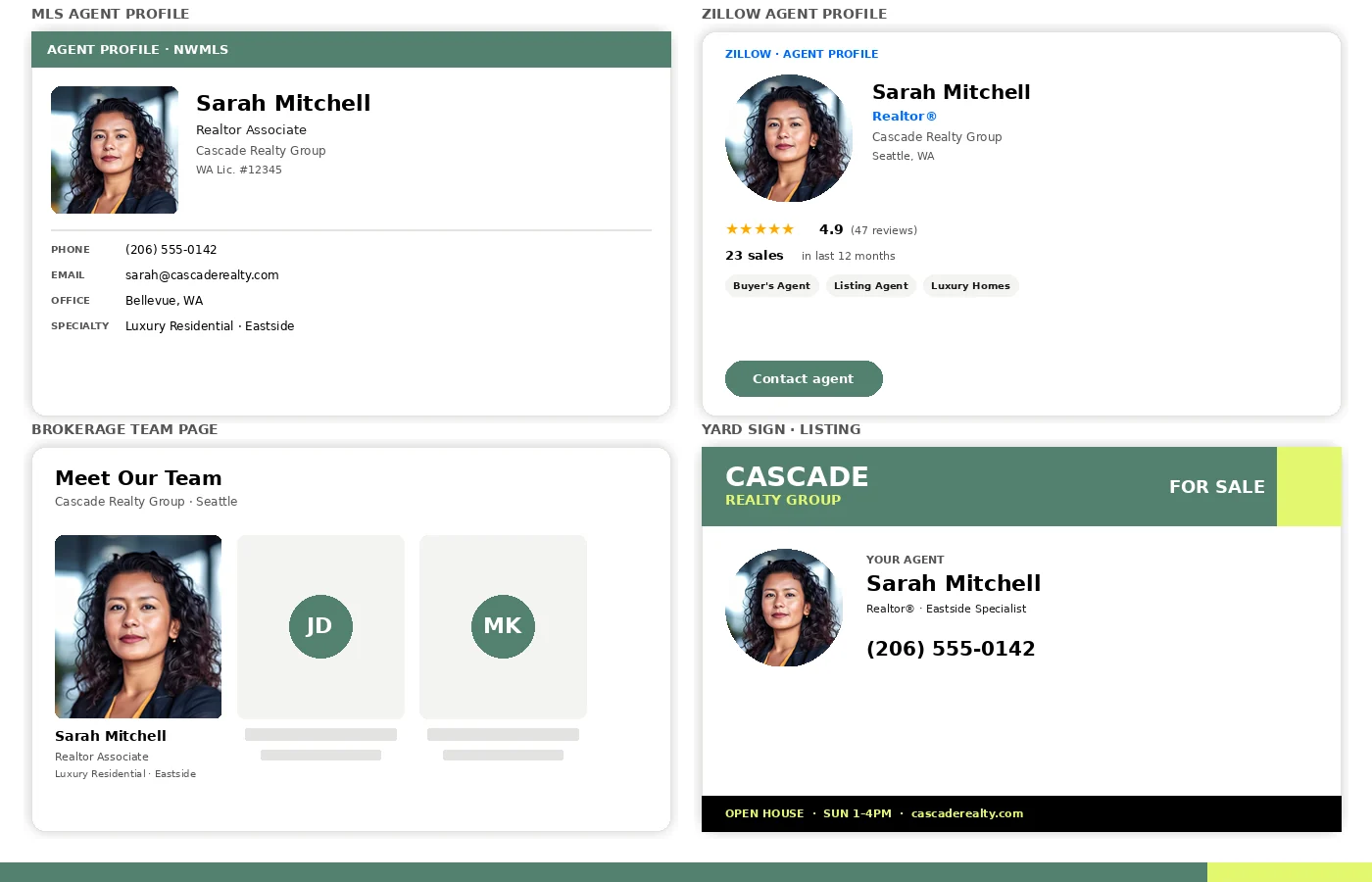
The places those headshots show up keep expanding. Beyond the brokerage website, agents need current photos for MLS, Zillow, Realtor.com, Homes.com. Listing presentations, business cards, signage, yard rider strips. Postcard mailers, email signatures, and social profiles on Instagram, Facebook, and LinkedIn. One agent's outdated or off-brand headshot can undermine the brand identity the team has spent years building.
The challenge isn't whether real estate teams need professional headshots. It's how to get them done quickly, consistently, and without making the office manager chase down forty agents for two months.

Who This Guide Helps
Large Brokerages
Multi-office firms with 50+ agents managing the long tail of MLS profiles, Zillow listings, agent bios, and listing-presentation collateral. The brand-cohesion play across markets.
Boutique & Specialty Brokerages
Luxury, commercial, and niche-market firms where headshots are part of the boutique positioning. Premium positioning demands a premium-looking team page.
Independent Teams & Solo Agents
Agent-led teams operating under a broker, plus solo agents managing their own personal brand across MLS, Zillow, postcards, and signage. The DIY tooling that keeps the photo line clean without an admin chasing down the photographer.
New & Expansion Markets
Brokerages opening new offices, switching franchises, or onboarding cohorts of agents at scale. Every new-market launch needs day-one team-page parity with the existing markets.
Match Attire to Market

Luxury Residential
Tailored suit and tie with a high-end residential backdrop. The polished register for agents working luxury markets, custom builds, and high-net-worth referrals where formal authority and visible attention to detail are part of the value proposition.

Suburban Residential
Approachable business casual with a familiar residential context. The friendly-expert register for agents working primary markets, first-time buyers, and family relocations where personal warmth converts more leads than formal polish.

Commercial Real Estate
Sharp formal attire with a polished interior backdrop. The deal-maker register for commercial agents, investment sales, and brokers whose clients evaluate gravitas and credibility before warmth.

Boutique / Urban Specialist
Modern professional in a brand-aligned setting. The contemporary register for boutique brokerages, urban specialists, and design-led agents whose differentiation runs on visual taste alongside market knowledge.
What's Modern in Real Estate Headshots in 2026
The 2026 real estate headshot moves toward soft natural-feel light, polished-but-approachable wardrobe, and clean intentional backdrops that work across MLS thumbnails, Zillow profiles, brokerage team pages, and yard signs at the same time. The biggest shift: residential agents increasingly opt for blazer-no-tie over the formal suit + tie default, especially in markets where warmth and trust convert better than gravitas.
See real real-estate headshot examplesWhat Professional Real Estate Headshots Look Like
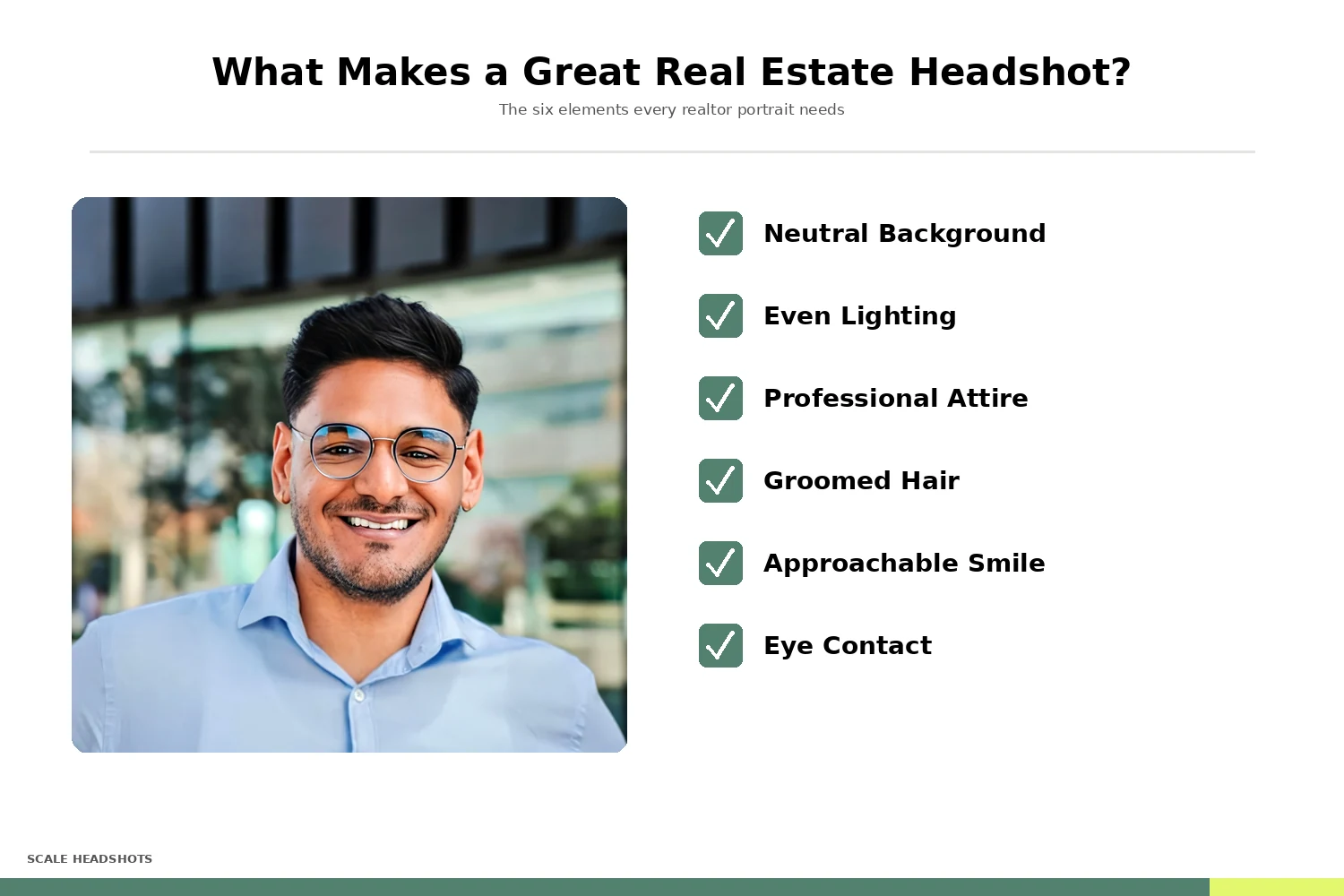
Real estate headshot standards vary by market, but a few principles hold across the board.
Attire should match the market the agent works. Luxury, commercial, and high-end residential markets typically call for a tailored suit or blazer with a solid blouse or dress shirt. Suburban residential, rural, and middle-market work tends toward business casual: a blazer over a simple top, a polished sweater, or a clean button-down. Solid colors photograph best at small sizes (MLS thumbnails, signage, mailer postage). Avoid busy patterns, large logos, and statement jewelry that competes with the face. The wardrobe should reinforce the agent's market positioning, not distract from it.

Expression carries more weight in real estate than almost anywhere else. Clients pick agents on perceived warmth and trustworthiness as much as on competence. The stiff corporate stare reads as cold and inaccessible to a homebuyer. The best realtor portraits suggest someone you'd want to meet at an open house, someone who'd actually return your call. Lean toward a slightly warm smile that shows a little teeth, not a closed-mouth executive expression. Research consistently finds that a teeth-showing smile builds significantly more trust than a closed-mouth one, with the caveat that an exaggerated grin reads as performative and less authentic.
Backgrounds should be simple and consistent across the team. Neutral solids (white, soft gray, navy, beige) translate well across every placement from MLS thumbnails to large-format yard signs. Environmental backgrounds (in front of a property, inside a model home, holding house keys) can work for individual marketing photos. They're nearly impossible to replicate across a forty-agent agency, and they create visual chaos on the team page.
Framing is typically head-and-shoulders or upper-chest. MLS and Zillow profile photos tend to crop to a square, so leave a bit of space around the head. You can always tighten the crop later. You can't recover pixels.
The single biggest quality issue agencies face isn't any one agent's photo. It's the inconsistency across the team.
See Real Examples
Browse 180+ real team headshots by industry, or compare 20 before-and-after enhancements.

The Brokerage Coordination Problem
Ask any office manager, marketing coordinator, or broker-owner about updating the team's headshots and you'll hear the same story. Getting every agent photographed with a consistent look is a logistical nightmare.
Traditional approaches create friction at every step. Booking an in-office headshot day means coordinating across forty agents, each running their own listings calendar, each protective of their open-house Saturdays. Multi-office agencies face the added complexity of flying a photographer to each location or pulling agents into a central session. That works for whoever's already nearby. It frustrates everyone else. The headshot day inevitably misses ten agents who were showing property, on vacation, or out sick. Those ten get rescheduled, miss the rebooked day, and eventually use a six-year-old photo from a previous brokerage.
The cost compounds quickly. A headshot day for forty agents at a per-agent rate of $150 to $500 lands somewhere between $6,000 and $20,000 once retouching, licensing, and logistics are factored in. And the moment a new agent joins, you're back to square one for that individual.
The result is what most agency team pages actually look like. A patchwork of LinkedIn profile shots, vacation cropouts, two-year-old portraits, and a few professional photos taken at the last firm-wide headshot day in 2023. The broker-owner spends the rebrand cycle chasing missing photos. The office manager spends every recruiting class trying to get new agents on the team page. The marketing coordinator spends every rebrand fielding requests for re-edits in seven different brand colors.
How to Capture Professional Headshots Without a Studio
You don't need a $5,000 firm-wide headshot day to get team photos that work. Modern smartphone cameras are more than capable of producing professional-quality images when paired with a few fundamentals. For agencies, the trick is removing as much friction as possible so each agent's capture takes 15 minutes, on their own schedule, anywhere they happen to be.
1. Lighting
Natural light from a large window is ideal. Position the agent facing the window (not with the window behind them) so light falls evenly across their face. Avoid direct overhead lighting; it creates harsh shadows under the eyes that read as fatigue. Mid-morning or late afternoon light is softest. Most brokerage offices have at least one window that works, and agents capturing from home will find similar light in any room with a south- or east-facing window.
2. Background
Keep it clean and uncluttered. A solid wall in the office or at home works. If you're capturing headshots for the full team, use a consistent background type for every agent, or rely on a platform that replaces the background to match a single brand standard.
3. Camera Position
Eye level or slightly above. A phone mounted on a small tripod at about five feet high gives the most natural perspective. Avoid shooting from below (unflattering and dated) or too far above (diminishing).
4. Framing
Mid-chest up, with some space above the head. Don't crop too tightly. MLS and Zillow profile photos typically crop to a square, and you want a clean bit of room to work with.
5. Coaching and Posing
Most agents are comfortable in front of a camera; the job demands it. But the headshot context is different from a listing video. Position the agent at a slight angle to the lens, around 45 degrees, with the head turned back toward the camera. Direct head-on framing reads as a mug shot. Fully turned reads as a magazine sidebar. The slight angle reads as natural and confident. Have them drop their shoulders, push the chin slightly forward and down to avoid double-chin compression, and take a breath before each shot. Coach for a smile that shows a little teeth (not a full grin) and have them think of something specific: a recent client win, the team they work with, the favorite house they ever sold. Take several photos in quick succession. The best headshot is usually captured 30 seconds in, after the agent stops thinking about being photographed.
These basics work whether the agent is in the office, at home, or on the road between showings. Same simple guidance for everyone, applied on whatever schedule fits each agent's calendar.
Set Up Your Studio in 10 Minutes
Admins customize the branding and headshot styles, then send invites to the team. Every agent captures on their own schedule. Scale handles the rest.
Where Real Estate Headshots Get Used
MLS Profiles
The first photo most buyers and sellers see. Cropped to square; outdated photos here cost showings.
Zillow & Realtor.com
The two largest consumer search platforms in real estate. Profile photos drive lead conversion at the top of the funnel.
Brokerage Team Page
The most visible placement of the brokerage brand. Inconsistent agent photos here suggest organizational drift.
Signage & Yard Riders
Yard sign rider strips, open-house A-frames, and listing signage. High-resolution print formats demand sharp source files.
Listing Presentations
The agent's branded pitch deck for sellers. Headshot appears on every page; outdated photos undermine the pitch.
Mailers, Cards & Social
Postcards, business cards, email signature, Instagram, Facebook, LinkedIn. One photo, every format.
Each of these channels benefits from one photo, every format. A single high-quality source image, formatted for every placement. No redo when the agency rebrands, no reshoot when an agent updates their bio.
Why Scale
The Scale Advantage for Real Estate Headshots
| Scale Headshots | Traditional Photography | |
|---|---|---|
| Cost per agent | Starting at $25 per headshot | $150 to $500+ per agent |
| Scheduling | Each agent self-serves on their own time | Coordinate calendars across the brokerage |
| Multi-office brokerages | Works anywhere with a phone and decent lighting | Send photographer to each location |
| New hires | Send an invite link | Schedule another session |
| Brand consistency | Automatic brand enforcement across all photos | Depends on photographer and brief |
| Turnaround | Minutes per headshot | Days to weeks |
| Quality control | Admin review dashboard with retake requests | One pass, then it's printed |
 Scale Headshots
How Much Could Your Brokerage Save?
100 agents x $150-$500 traditional = $15,000 to $50,000. The same brokerage with Scale: $2,500. 83-95%+ savings, credits never expire.
How Scale Headshots Works for Real Estate Brokerages
Scale Headshots is the self-service company headshots platform built for exactly this situation: organizations that need professional, consistent headshots across a team, from 5 people to 50,000+, without the logistics of traditional photography. Here's how it works for a real estate team.
1. Set Up Your Studio
An admin (office manager, marketing coordinator, or broker-owner) creates your studio, customizes the branding, headshot styles, and formatting preferences in about ten minutes. The platform is free to set up. You only pay for approved headshots.
2. Invite Your Agents
Each agent receives a link to capture their headshot. They use their phone or laptop camera, following guided instructions for positioning, lighting, and framing. No app download required. The capture happens at the office, at home, or between showings, on their own schedule.
3. AI Enhances the Real Photo
Scale doesn't generate a synthetic image. It takes the actual photo your agent captured and enhances it: correcting lighting, removing the background, applying your chosen style, upscaling quality. The result is a real photo of a real person, polished to professional standards. That matters in real estate, where authenticity isn't negotiable. The client meeting an agent at an open house should see the same person they saw on Zillow.
4. Review and Approve
The admin reviews every headshot in a dashboard before it goes live. If a submission doesn't meet the standard, the agent can retake it (up to five retakes per credit). The office gets quality control without anyone chasing down a reshoot.
5. One Photo, Every Format
Once approved, each headshot can be exported for any use: MLS thumbnail, Zillow profile, Realtor.com, the team page, signage, listing presentations, business cards, mailers, email signature, social. One capture, every placement.
6. Ongoing Access
When a new agent joins, an existing agent moves teams, or a rebrand triggers a refresh, captures happen through the same platform. No need to rebook a photographer or coordinate across calendars. Credits start at $25 per headshot, with volume pricing for larger agencies and multi-office franchises.
The outcome customers describe is simple: leveling up your branding across every place your agents show up.
Automate Headshot Delivery Across Your Brokerage
Scale's REST API with webhooks keeps agent headshots fresh across the systems your brokerage already uses. MLS profiles, brokerage CRM, listing software.
- Sync to brokerage CRM platforms (CINC, kvCORE, Sierra Interactive, Chime).
- Push to brokerage website and team pages on hire.
- Update email signature managers (Exclaimer, WiseStamp).
- API access for custom workflows and MLS connections.

What teams are saying
Studio has significantly reduced that time spent, as backgrounds are pre-set and people are able to take their own headshots remotely without a professional photographer. It takes a lot of the legwork out of it.
— TNAA
Ready to Update Your Agency Headshots?
Capture consistent, professional headshots across every agent. No photographers. No scheduling. No editing. The modern, seamless way.
Headshots for your company size
Individual brokerages
Self-service company headshots for smaller teams, captured from any device.
Small Business HeadshotsSmall real estate teams
Team headshots for founders and distributed teams, brand-consistent at any size.
Team HeadshotsReal Estate Headshot FAQ
How much does a real estate headshot cost?
A real estate headshot from a traditional photographer runs $150 to $500 per agent for a standard session, with the US average around $232. Full-day agency shoots typically land between $3,500 and $6,000+ once retouching, licensing, and travel are factored in. Major-metro and luxury markets push the per-person cost above $500, with editorial-style branding sessions running $700+. Scale Headshots is the lower-cost alternative: credits start at $25 per headshot with volume pricing for full team rollouts and multi-office franchises. The platform is free to set up; you only pay for approved headshots.
What should a realtor wear for a headshot?
Match the wardrobe to the market. Luxury, commercial, and high-end residential markets call for a tailored suit or blazer with a solid blouse or dress shirt. Suburban residential, rural, and middle-market work leans business casual: a blazer over a simple top, a polished sweater, or a clean button-down. Solid colors photograph best at small sizes (MLS thumbnails, signage, postage). Avoid busy patterns, large logos, and statement jewelry that compete with the face. Across the team, consistency matters more than any individual choice. If half the agents are in formal suits and half are in polos, the team page reads as misaligned even if both choices are appropriate on their own.
What background works best for a real estate headshot?
Neutral solid backgrounds (white, soft gray, navy, beige) are the safest choice. They translate well across every placement from MLS thumbnails to large-format yard signs. Environmental backgrounds (in front of a property, in a model home, holding house keys) can work for individual agent marketing photos but are nearly impossible to replicate across a brokerage and create visual chaos on the team page. With Scale Headshots, the admin sets a single standard background that's automatically applied to every agent's photo, so the team page looks unified regardless of where each agent captured.
How often should real estate agents update their headshots?
Industry guidance lands at one to three years for most agents. Top-performing agents refresh every 12 to 24 months as part of staying competitive. Update sooner than the regular schedule if the agent has changed hairstyle, gained or lost significant weight, started wearing glasses, or moved to a new brokerage. The look-like-your-headshot rule matters more in real estate than almost anywhere else. Clients evaluate the agent on Zillow before they ever shake hands, and a major mismatch breaks the trust signal. Team pages benefit from refreshing the entire roster at once when a brand identity changes; piecemeal updates create the patchwork look that buyers and recruits notice quickly.
Can a real estate headshot be captured with a phone?
Yes. Modern smartphone cameras produce professional-quality real estate headshots when paired with three things: good natural lighting (a large window with the agent facing it works best), a clean uncluttered background (a solid wall), and a phone mounted at eye level. Scale Headshots provides guided capture instructions that walk each agent through framing, lighting, and posture. The capture takes about 15 minutes. It can happen at the brokerage office, the agent's home, or anywhere with decent natural light. AI enhancement handles background replacement, lighting correction, and brand-aligned styling from there.
What's the difference between MLS, Zillow, and Realtor.com profile photo requirements?
The platforms use slightly different sizing and crop ratios but the underlying requirements are similar: a clear, recent, professional headshot of the agent. Not a logo. Not a property photo. Not a photo with a partner. MLS profile photos crop to a square at small sizes, so leave a bit of room around the head to make the crop work on every platform. Zillow and Realtor.com prefer high-resolution source files so the photo scales cleanly between mobile and desktop. Scale Headshots produces one source image and exports the formats needed for each platform automatically.
How do you keep real estate headshots consistent across an entire brokerage?
Scale Headshots applies the same background style, color treatment, and formatting to every agent's capture, regardless of where each person actually shot. The admin configures the team's standard once at the platform level. Every submission renders against that standard automatically. The result is a unified team page whether the top producer captured at the office, the new buyer's agent captured at home, and the luxury specialist captured between showings. New agents joining the agency receive an invite link to the existing studio and capture using the same standard, so the team page stays unified through hires and rebrands.
How should you pose for a real estate headshot?
Stand or sit at a slight angle to the camera, around 45 degrees, with the head turned back toward the lens. Direct head-on framing reads as a mug shot. Fully turned reads as a magazine sidebar. The slight angle reads as natural and confident. Drop the shoulders so the posture is upright but not rigid. Push the chin slightly forward and down to avoid double-chin compression. Smile with the eyes, not just the mouth, and show a little teeth. Research consistently finds that a teeth-showing smile builds significantly more trust than a closed-mouth one, with the caveat that an exaggerated grin reads as performative. Avoid crossed arms, hands on hips, and head tilts past about 10 degrees.
Are AI-generated headshots a good choice for real estate agents?
No. AI-generated headshot tools are now widely marketed to real estate (Dreamwave, Aragon, Aisuitup, Secta, Photopacks, Pixelbin, BetterPic, HeadshotPro). Many claim results indistinguishable from real photos. But the model creates synthetic images trained on the agent's selfies. The output isn't actually a photo of the agent. Real estate is a relationship business. The client meeting you at an open house should recognize the same person they saw on Zillow. A synthetic likeness, even a flattering one, breaks the trust signal the headshot is supposed to send and creates a real-world disconnect at the moment trust matters most. Scale Headshots takes the opposite approach: real photos captured by the agent, enhanced through AI for quality (lighting, background, upscaling). Real photos, AI-enhanced quality.
Is there volume pricing for brokerages and franchises?
Yes. Credits start at $25 per headshot for smaller teams. Volume pricing scales down significantly for larger agencies, multi-office operations, and franchise rollouts. For organizations doing a full enterprise headshot rollout (5 people to 50,000+), per-headshot cost drops below $10 at scale. Volume quotes are based on size and refresh cadence.
Still have questions? Get in touch and we'll be happy to help!