Tips
What Makes a Corporate Headshot Modern? How to Choose One Look for Your Whole Team
A modern corporate headshot is five decisions, not a trend. Here's what each one changes, which looks suit which kind of company, and how to keep one look consistent across a whole team.
 Michael Hall
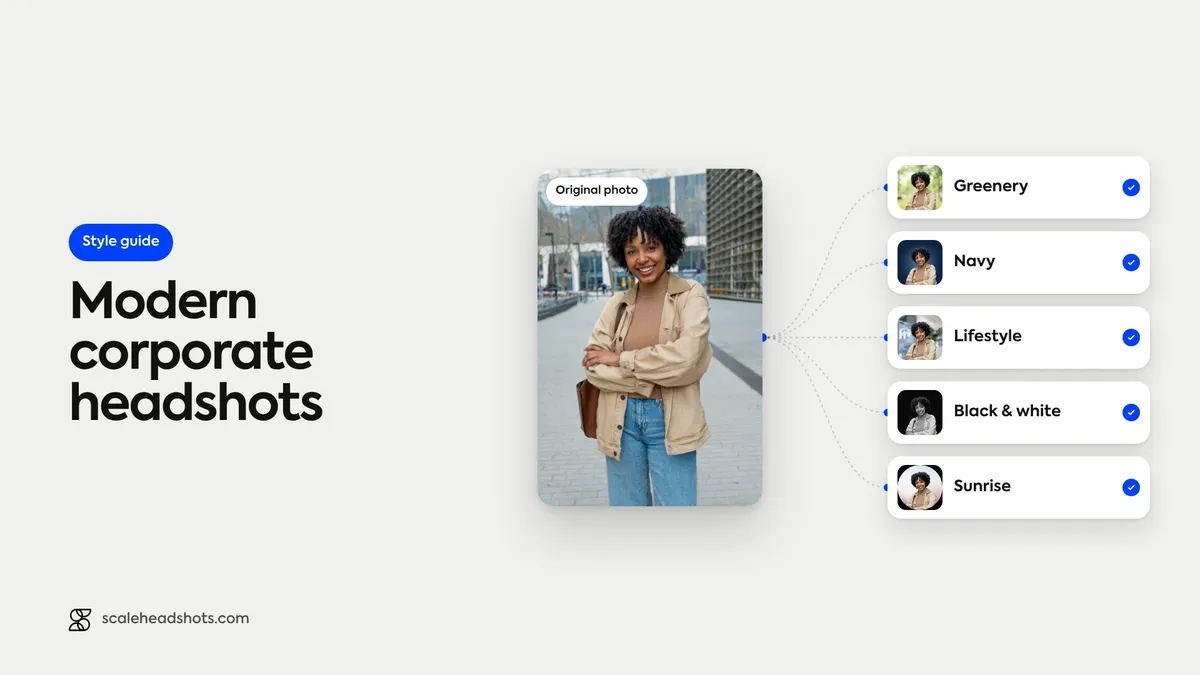
Pull up the team page of a company that's been around a few years, and the headshots tell you when each person joined. The early ones sit in front of a gray backdrop, lit hard from the front and cropped tight. The newer ones are softer: warmer light, a lighter background, a relaxed expression. Neither set is wrong. Side by side, they read as a patchwork.
That's the real problem with modern corporate headshots, and it's a company problem more than a style problem. A modern look is easy to recognize and hard to apply evenly. One person picks an office background, another shoots by a window, a third smiles the way people smiled in 2015, and the look that was supposed to feel current turns into five different looks.
This guide breaks a modern (or contemporary) corporate headshot into the five choices that actually make it up, shows which looks suit which kind of company, and walks through how to pick one look and hold it across every person, including the ones who start next month. If you're choosing a look for yourself, the same five choices apply. You just don't have to match anyone.
What is a modern corporate headshot?
A modern corporate headshot is a real photo with soft, even light, a clean or lightly textured background, relaxed head-and-shoulders framing, and a natural expression, in clothes the person would actually wear to work. It replaces the stiff, hard-lit studio portrait with something warmer and more current. For a company, it only works when every employee's photo follows the same choices.
What makes a corporate headshot look modern?
Five choices do almost all of the work. Three of them (background, light and framing) are properties of the photo. Two (wardrobe and expression) belong to the person in it. Knowing which is which decides how you roll a look out across a team.
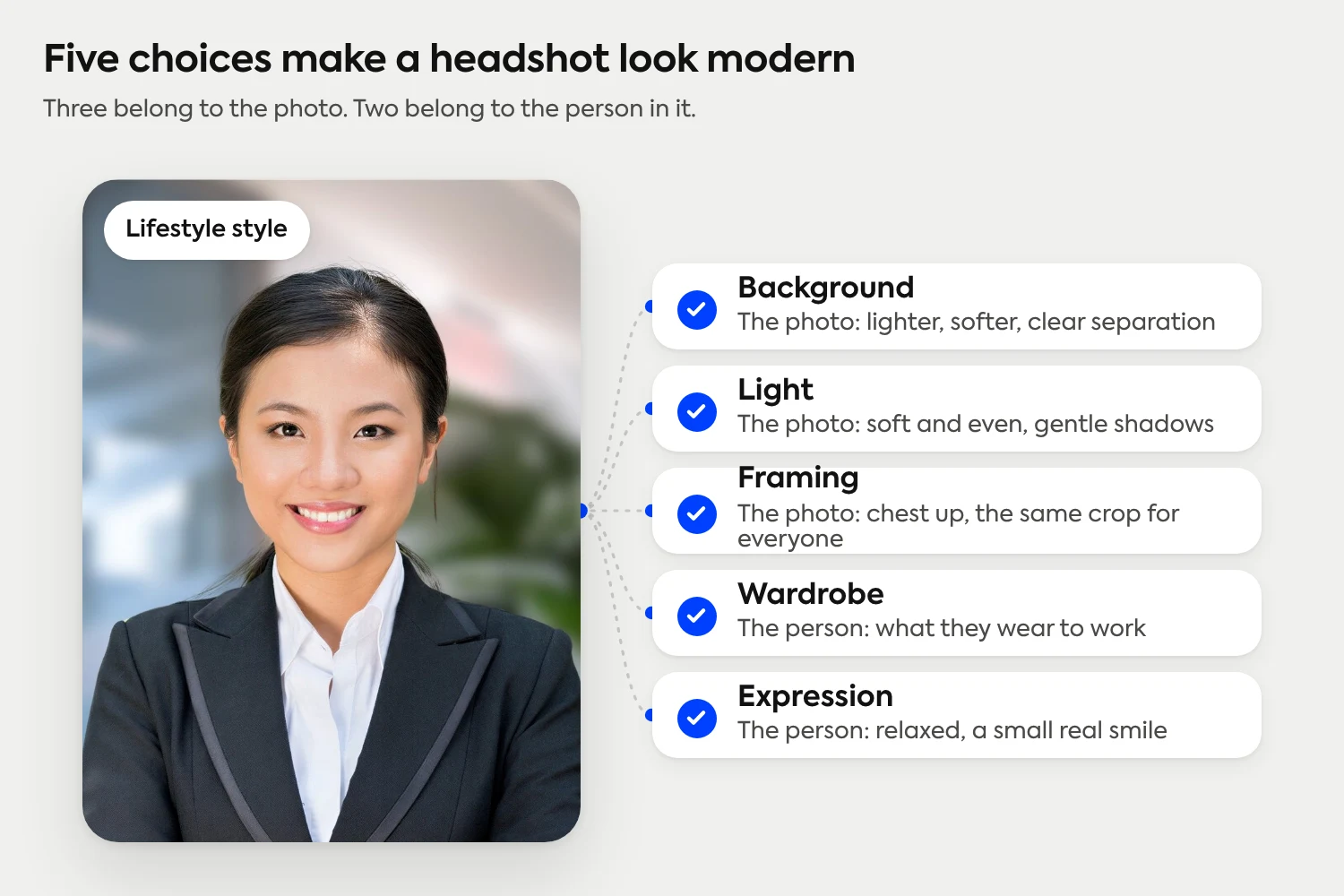
Background. The traditional corporate backdrop is flat gray or white, there to stay out of the way. The modern version still stays out of the way, but it's lighter, softer, or carries a hint of texture or color. The test is separation: the person should stand clearly apart from the background without a busy setting competing for attention. This is also the choice that breaks consistency most often, because an "environmental" background (an office, a street, a garden) is different for every person who shoots their own. Our guide to headshot backgrounds that photograph well goes through what holds up behind a face.
Light. Modern light is soft and even. It wraps around the face with gentle shadows instead of flattening it. A large window or any big, diffused source does this well. The dated look is hard light straight from the camera's direction: bright, flat, and a little interrogative.
Framing. Head and shoulders down to mid-chest, camera at eye level, with a little room above the head. Modern framing is often slightly looser than the tight formal crop, which gives the photo some air. What matters more than the exact crop is that it's the same crop. When the eye line sits at the same height in every tile of a team page, the set looks designed.
Wardrobe. Modern wardrobe means dressed the way the person dresses for work, not dressed for a portrait. Solid, mid-tone colors and a good fit still photograph best, whether that's a blazer, a knit or an open collar. Our guide to dressing for the camera covers colors, patterns and the details that show up on camera.
Expression. This is the biggest tell. The old corporate expression is either stern or a posed grin. The modern one is relaxed: a small, real smile, direct eye contact, shoulders down. It's also the one thing nobody can set for the team, which is why it deserves a sentence in your instructions. Our notes on posing and expression are a good starting point for people who freeze in front of a lens.

Which modern corporate headshot style fits your company?
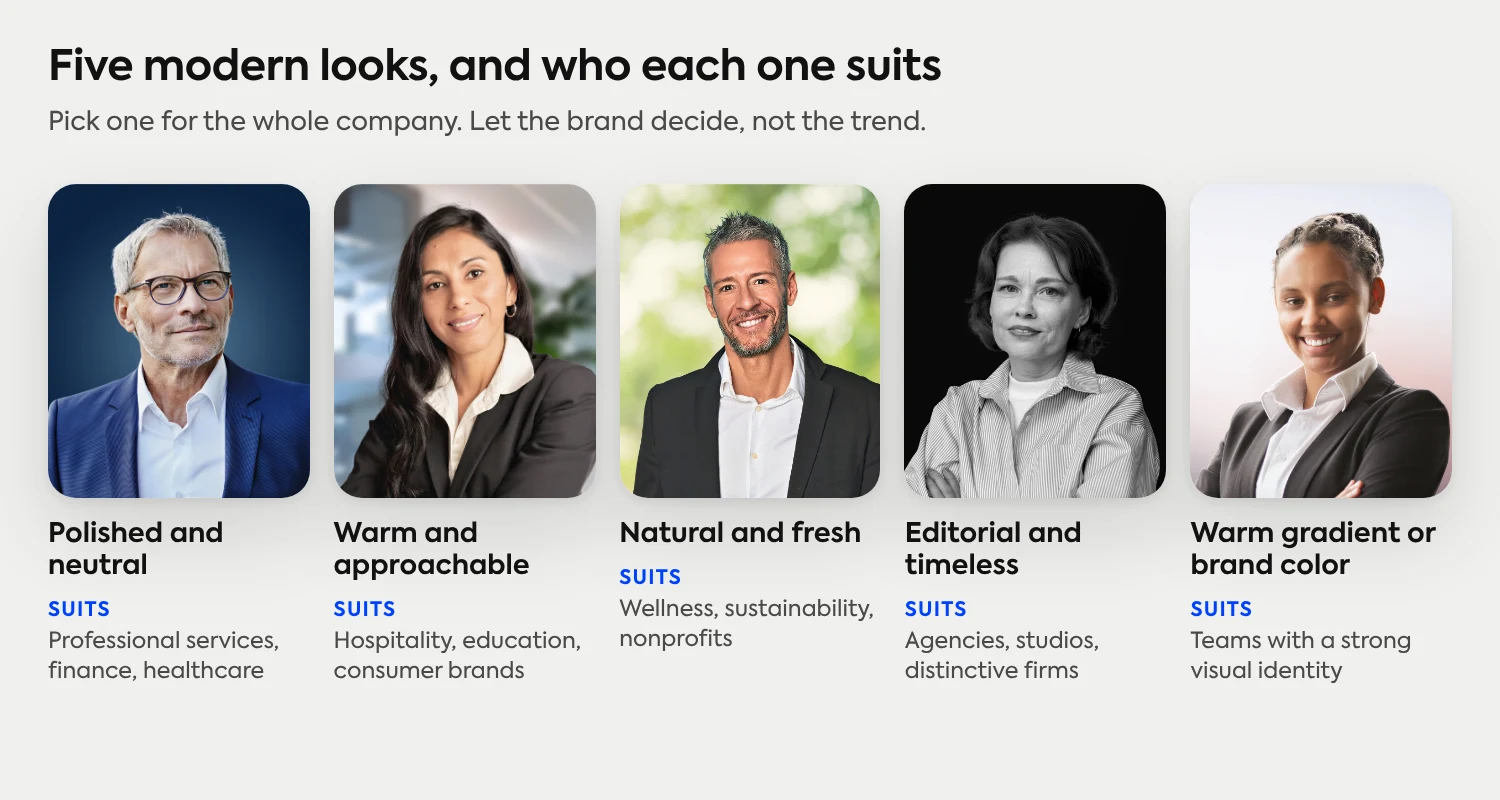
"Modern" isn't one style. It's a range, and where a company lands on it should follow its brand and the people looking at its photos, not whatever is popular this year. Five looks give you a useful map:
Polished and neutral. A soft gray or deep navy background, even light and business attire. It reads as modern through the light and the expression, not the setting. It suits professional services, finance, healthcare and any team selling to cautious buyers.
Warm and approachable. Warmer light, a softly blurred or lifestyle-feeling background and a relaxed smile. It suits hospitality, education, consumer brands and companies where the people are the product.
Natural and fresh. A soft greenery or outdoor-feeling backdrop. It suits wellness, sustainability, nonprofits and teams that want to look open and unhurried.
Editorial and timeless. Black and white with strong contrast. It also quietly solves a hard team problem: when everyone wore a different color, removing color makes the set match. It suits agencies, studios and firms that want to look distinctive.
Brand-colored or warm gradient. A sunrise-toned or brand-tinted backdrop that gives the team page a point of view. It suits teams with a strong visual identity who want the photos to feel like part of it.
Most companies are better served by one of these than by a mix. If your people dress down day to day and a polished-neutral look would feel like a costume, our guide to dress-down looks for relaxed teams goes deeper on that end of the range.
Leaning creative or expressive?
Teams with a strong visual identity often want bolder backgrounds and more personality than a neutral look allows. The guide covers that range in detail, with examples by field and notes on keeping an expressive set consistent.
Explore brand-forward styles in depthHow do you choose one modern look and keep it consistent?
The decision is smaller than it feels. You're not picking a photographer's portfolio. You're picking one answer to each of five questions and writing it down once. Here's the order that works:
Start with the brand, not the trend. Look at your website, your deck and your logo, and decide whether the company reads as polished, warm or expressive. The headshot should look like it belongs on the same page.
Choose the background first. It's the biggest single signal and the hardest to fix later. Pick one background for the directory, and make sure it separates from the clothes people actually wear: a navy top on a navy backdrop disappears.
Fix the crop and the eye line. Same head-and-shoulders framing, camera at eye level, same space above the head, for every person.
Describe the expression in a sentence. Something like "relaxed, a small real smile, looking at the camera." Put that sentence in the invite so nobody has to guess.
Send one wardrobe note. Solid, mid-tone, well fitting, the way they'd dress for a good meeting. Keep it to a few lines, and send it with the invite.
Try the look on different people before you roll it out. A look that works on the first person tells you very little. Test it on a handful of people with different hair, skin tones and clothing, and check that the set still holds together.

Once the look is chosen, the work is keeping it. New hires arrive, people change their hair, and someone retakes a photo two years later. Our standardization guide covers the six variables worth writing down so the next photo matches the last one. If your team is spread across cities, the same logic applies with more at stake, and we walk through it in how remote teams get a consistent set.
Can a whole company get a modern look without a photo day?
Yes, and for many teams it's the practical way to do it. A photographer can deliver a modern look beautifully for a team that's in one place on one day. It gets harder when people work in different cities, when a third of the team is hybrid, or when someone starts the week after the shoot. Then the look has to travel to the person, not the other way around.
That's the job Scale does. Each employee captures their own photo on their phone through a guided link. Studio 2, Scale's capture experience, gives live guidance and lighting feedback and lets them review and retake before they submit. Then Scale's AI edits the photo: background, lighting, framing and upscaling, the same way for everyone, so the set matches no matter where each person was standing. An admin approves each headshot or requests a retake, with up to four retakes per submission.
Those three photo-level choices, the background, the light and the framing, are exactly the ones that break consistency when people shoot on their own. They're also the ones that get applied centrally. The two that belong to the person, wardrobe and expression, stay with the person. Scale edits the photo, never the person, which is why a modern look still feels like them.

That difference matters most when someone is comparing options. AI headshot generators create a new, synthetic image from training photos. Scale is AI edited, not generated: the headshot is the real photo your employee took, with the background and light brought into line. For a look built on natural expression, and for photos that end up on badges and in directories, the real photo is the point.
One captured photo can also come back in more than one look and in every format a team uses, so the company can compare a few styles before committing to one. Setup is free, credits start at $25 per headshot, you get 3 free credits on signup, and there are no subscriptions or contracts. To see what a consistent set looks like, browse finished examples. To start, read about setting up a studio for your whole team.
Frequently Asked Questions
What is a modern corporate headshot?
A modern corporate headshot is a real photo with soft light, a clean or lightly textured background, relaxed head-and-shoulders framing and a natural expression. It trades the stiff, hard-lit studio portrait for something warmer and more current while still looking professional on a team page or a LinkedIn profile.
What's the difference between modern and traditional corporate headshots?
Traditional corporate headshots use a flat gray or white backdrop, hard front lighting, a tight formal crop and a serious or posed expression. Modern headshots use softer light, a lighter or lightly textured background, slightly looser framing and a relaxed, genuine expression.
Are contemporary corporate headshots less formal?
Not necessarily. Modern describes the light, background and expression, not the dress code. A navy blazer on a soft background with even light is both formal and modern. Contemporary looks can run from business formal to relaxed, as long as the choices are consistent.
What background works best for modern corporate headshots?
A clean, lighter or lightly textured background that contrasts with the clothing works best. Soft gray, warm neutrals, deep navy and gentle greenery all read as modern. Avoid busy settings, and avoid a backdrop close in color to what people usually wear, because the person blends into it.
How do you keep modern headshots consistent across a team?
Choose one background, one crop and one expression, write them down, and apply them to every person. The easiest way to hold them is to capture through one shared process so the same background, light and framing are applied centrally instead of being decided by each person.
Do modern corporate headshots need a photographer?
No. The look comes from light, background, framing and expression, and a guided phone capture, edited centrally, can deliver all four. A photographer is still a good choice for an editorial or brand shoot, or a team that's in one place on one day. A platform fits better when people are spread out or hire on a rolling basis.
Still have questions? Get in touch and we'll be happy to help!
Choose the look once, apply it to everyone
Your team captures real photos on their own phones, an admin approves each one, and Scale applies the same background, light and framing to every headshot. AI edited, not generated. Free to set up, credits from $25 per headshot, and 3 free credits to try it.