Industry
Why Your Company Needs Professional Team Headshots
Professional headshots aren't a nice-to-have for a company. They're brand consistency, internal connection, and customer trust, captured once and managed in one place.
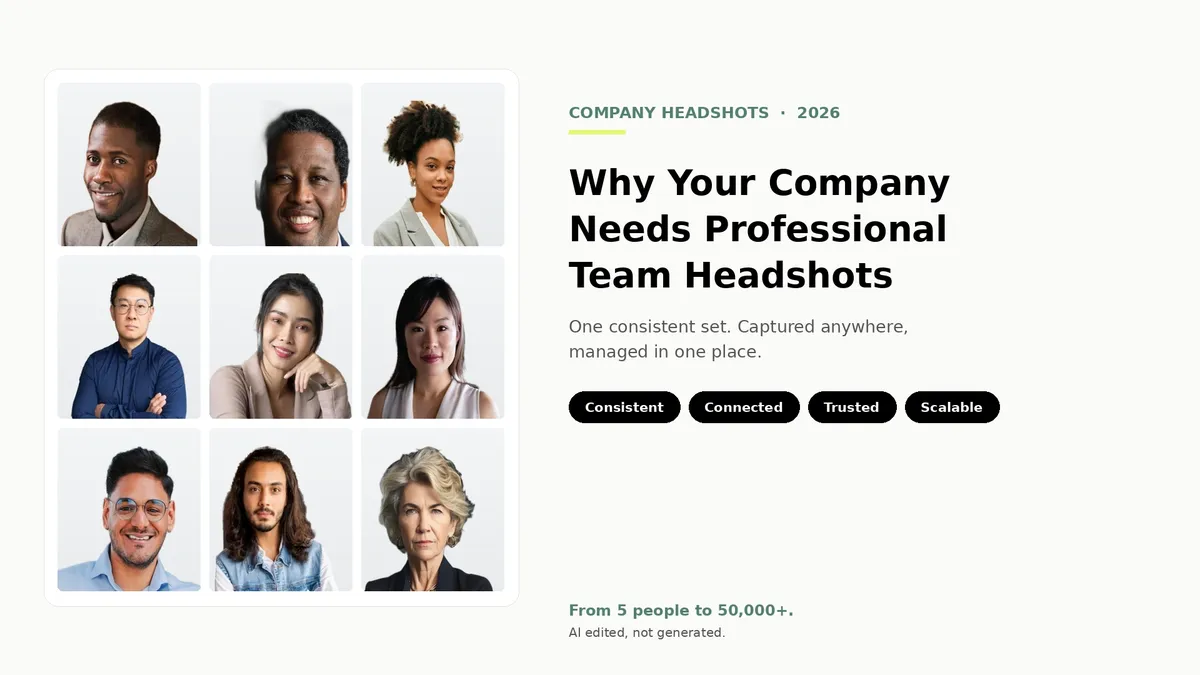
Open your company's team page and look at it the way a prospect would. Forty people, forty different backgrounds. One photo is a cropped wedding shot, one is a dim selfie, three are the gray placeholder avatar, and the new hire from last week isn't on there at all. Every one of those photos was fine on its own. Together, they quietly tell a visitor that the details don't get tended to here.
That patchwork is the real cost of not having a plan for headshots, and it shows up everywhere your people do: the website, LinkedIn, sales decks, email signatures, the internal directory. A company's headshots are part of its brand whether you manage them or not. The only question is whether they're working for you.
The good news is that getting a consistent, professional set for your whole team no longer means booking a photographer or settling for an AI generator that invents faces. Here's why company headshots matter, and how to get them without the old headaches.
Why does a company need professional headshots?
Because a team's headshots are a brand asset that shows up everywhere customers and colleagues look: the website, LinkedIn, decks, email signatures, and internal directories. A consistent, professional set signals that the company is organized and trustworthy, helps remote teammates connect names to faces, and humanizes every customer touchpoint. Inconsistent or missing photos quietly undercut an otherwise polished brand.

1. A consistent team looks like a company that has it together
Consistency is the difference between a team page that looks designed and one that looks assembled from whatever everyone had on their phone. When every headshot shares the same framing, lighting, and finish, the whole set reads as deliberate, and that polish transfers to how people judge the company behind it.
Your team's photos show up in more places than most companies track: the about page and team page, LinkedIn profiles and company posts, pitch decks and proposals, conference bios and press kits, email signatures, and the internal directory. A consistent set of company headshots makes all of those surfaces look like they belong to the same organization. A mismatched set makes even a strong brand look slightly off, and prospects feel that before they can name it.
2. Headshots connect remote and hybrid teams
When your team is spread across cities, time zones, or continents, a lot of colleagues will work together for months without ever being in the same room. Headshots do quiet but real work here: they let people put a face to a name in Slack, Teams, the org chart, and the internal directory, which makes every message feel a little more human and a little less like talking to a handle.
For a growing or distributed team, that familiarity compounds. New projects spin up faster when people recognize each other, cross-department introductions feel warmer, and the company feels like one team instead of a list of usernames. A consistent set of team headshots is one of the cheapest ways to make a remote culture feel connected.
3. Real faces build customer trust
A headshot is a visual handshake. When a customer can see the real person they're emailing, meeting, or buying from, the interaction stops feeling like a transaction with a faceless company and starts feeling like a relationship with a person. That matters most in businesses where trust drives revenue: consulting, professional services, real estate, finance, healthcare, and any team that sells through relationships.
There's a specific reason real photos matter more than ever. As AI-generated profile images spread, a verifiably real photo of a real person reads as more trustworthy, not less. Scale is built on that principle: we work with the actual photo of your team member and enhance it. We don't fabricate a synthetic face. It's a small signal, and it's the right one to send to a customer deciding whether to trust you.

4. New hires get a headshot on day one, not next quarter
Most companies get headshots in a burst: they organize a shoot, photograph whoever is in the office that day, and then the set slowly goes stale as people join and leave. Six months later half the team is missing or out of date, and you're back to the patchwork.
Treating headshots as part of onboarding fixes that. When a new hire can capture a professional photo on their first day, from wherever they are, they show up complete: on the team page, in the directory, in Slack, in their email signature, from the start. That makes new people feel included immediately, and it keeps the whole set current without anyone having to organize another shoot.
5. Headshots scale without a photographer
The traditional way to photograph a team doesn't scale. Booking a photographer runs roughly $150 to $500 per person, and that's before the logistics: coordinating calendars, flying someone to multiple offices, chasing the people who missed the slot, and waiting weeks for edited files. For a distributed team, it's close to impossible to get everyone in front of the same lens.
A self-service platform removes the bottleneck. Each team member captures their own photo from any device, wherever they are, and the platform handles the rest: background, lighting, color, and consistent output across every format. It works the same for five people or 50,000, and at a per-credit cost it's a fraction of traditional photography. The logistics that used to make a company-wide refresh a project become a link you send around.
Different teams, different expectations
What reads as polished for a creative agency can look too casual for a law firm or a hospital, and the reverse is true too. Our industry guides break down what each field expects for attire, background, and tone, with real examples, so your team's set fits how your market reads professionalism.
See the industry guidesHow to get consistent headshots for your whole team
Here's the part that makes all of the above practical instead of aspirational. With Scale, an admin sets up a studio and sends invites with reminders, your team members capture their own headshots on their own time from any device, and the platform enhances and delivers each one in every format you need: square for LinkedIn, a transparent PNG for badges and the directory, a signature crop for email, full resolution for the website. You manage the whole set, with moderation and retakes, from one dashboard.
This is AI edited, not generated. The platform improves the real photo each person captured, by cleaning up the background, balancing the lighting, correcting color, and upscaling the image. It does not invent a face, swap someone's outfit, or generate a person who doesn't exist. Everyone still looks like themselves, which is exactly what you want on a badge, a directory, and a customer-facing profile. See how the finishing works on our features page, or browse real examples to see the consistency on a full set.

How much do company headshots cost?
Traditional team photography typically runs $150 to $500 per person once you account for the photographer, studio time, and editing, and more when travel to multiple offices is involved. A self-service platform changes the math: Scale starts at $25 per headshot credit, with volume pricing that scales below that for large teams, and every account gets three free credits to start. There are no subscriptions or contracts.
For a 40-person team, that's the difference between a five-figure project with weeks of coordination and a per-credit cost you can run on your own timeline. You can see current pricing and try it with the free credits before committing the whole team.
How do you get headshots for a remote team?
You skip the shoot entirely. Instead of getting everyone to one location, each person captures their own photo wherever they are, on a phone or laptop, following simple guidance for light and framing. The platform then standardizes the results so a team scattered across home offices and time zones comes back as one consistent set.
That's the whole reason a self-service platform exists: it turns a logistics problem into a link. If your team is capturing on their own, our guides on taking a headshot with an iPhone and at home cover the few choices that make a phone photo look professional before it's enhanced.
Frequently Asked Questions
Why does a company need professional headshots?
[object Object]
What makes a good set of company headshots?
[object Object]
How do you get consistent headshots for a remote or distributed team?
[object Object]
How much do professional company headshots cost?
[object Object]
Do company headshots actually affect customer trust?
[object Object]
How often should a company update its team headshots?
[object Object]
Can you get company headshots without hiring a photographer?
[object Object]
Still have questions? Get in touch and we'll be happy to help!
Give your whole team one consistent look
Set up a studio, send your team a link, and let everyone capture a professional headshot from anywhere. Scale finishes each one with a clean background, balanced light, and every format you need, managed from one dashboard. Real photos of your real team, AI edited, not generated. Your first three credits are on us.