Industry
How to Keep Faculty and Staff Headshots Consistent Across a University
A university's faculty directory collects mismatched photos one hire at a time. Here's how institutions set one standard across every department and school.
 Ben LoBue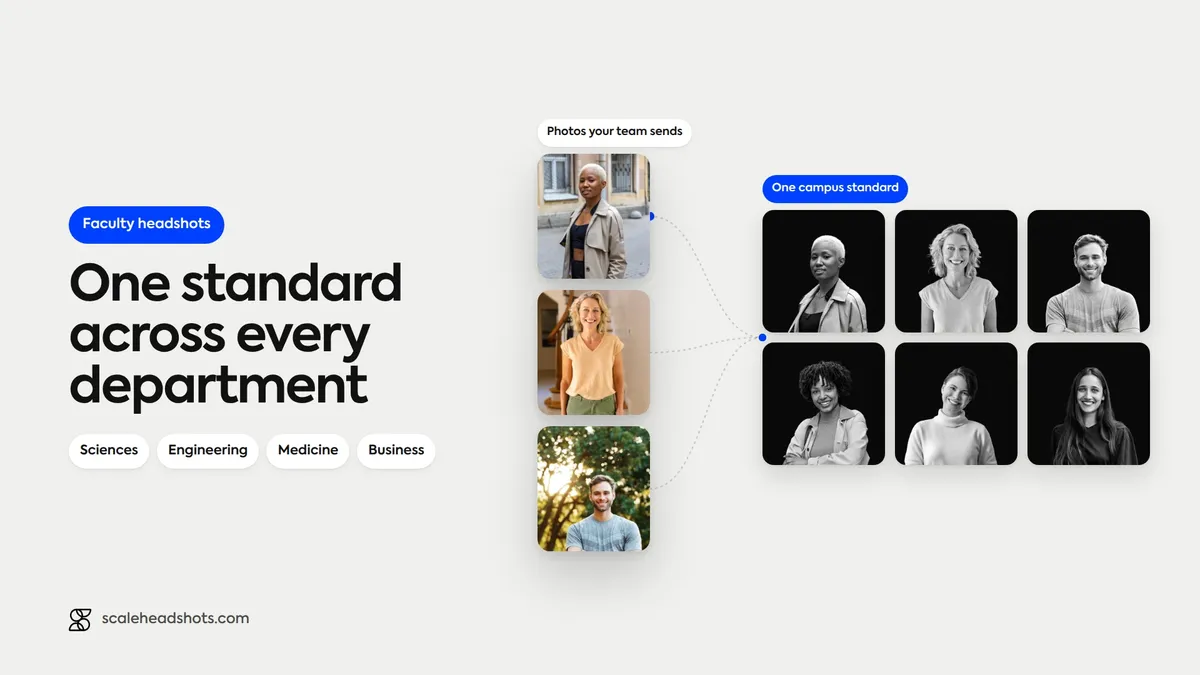
Open almost any university's faculty directory and the photos tell their own story. A few studio portraits from a hiring push a decade ago. Some cropped conference snaps. A handful of phone selfies. And plenty of gray placeholders where someone never got around to it. Across hundreds of faculty, dozens of departments, and constant turnover every term, the directory turns into a patchwork that the whole institution can see.
Coordinating a single campus photo day for everyone has never been realistic, which is exactly why the drift happens. People join at different times, work across multiple campuses, and the department admin chasing photos has more pressing things to do. The fix isn't a bigger photo day. It's one standard that every faculty and staff member can capture against, from anywhere, and a way to keep new hires on it.
Here's how institutions get a consistent, professional set across every department, and keep it that way.
How do universities keep faculty headshots consistent?
They set one institutional standard, the same background, lighting, and finish, and have faculty and staff capture against it instead of organizing campus photo days. A self-service platform lets people across every department and campus capture from any device and standardizes the results to brand guidelines, with moderation to keep the directory on-spec and new hires added to the same look each term. Attire can flex by discipline; the visual standard stays fixed.
Why faculty directories drift (and why prospective students notice)
Faculty directories drift for structural reasons, not negligence. A research university hires continuously, across many schools, often spread over more than one campus. There's rarely a moment when everyone is available for the same shoot, and there's no single owner of "how faculty photos should look." So each department, and each hire, ends up doing its own thing, and a few years later you have a dozen visual standards instead of one.
It shows where it matters most. Prospective students and their families judge a program partly by its website. Faculty being recruited look at who they'd be joining. Peer institutions and the press pull from your directory. A page of mismatched photos quietly undercuts an otherwise strong department, while a consistent set signals an institution that pays attention to detail.
Consistency reads as institutional credibility
When every faculty and staff member shares one standard, the department page, the school's site, individual faculty profiles, and the broader university presence all read as one institution rather than a collection of personal pages. That coherence does real work in recruiting, both students and faculty, and in how the institution presents itself to funders, partners, and the public.
It's the same underlying consistency problem any large organization faces; the academic version just plays out across schools and departments instead of business units. If you're standardizing across a complex org of any kind, the approach in our piece on keeping team headshots consistent across departments applies directly.
It's also the equitable option
A self-service standard is the fairest way to handle faculty photos. Everyone gets the same professional quality regardless of when they joined, which campus they're on, whether they had access to a photographer, or what their department's budget looks like. A new adjunct and a department chair end up with photos that belong to the same set.
That removes the quiet inequity of a directory where some people have polished portraits and others are stuck with a placeholder or a low-quality crop. Consistency isn't only about looking organized; it's about treating everyone the same way.
One standard, room for each discipline
A consistent directory doesn't mean everyone looks identical. The fixed part is the background, lighting, and finish, the institutional standard. Attire and tone can still flex by discipline, so a humanities professor, a clinician, and an engineering researcher can each look appropriate to their field while clearly belonging to the same set.
See the guidesHow to roll it out across every department
The mechanics are simpler than a campus shoot. Pick one style and background as the institutional standard. Then make it a single capture flow that faculty and staff in every department, school, and campus use the same way: capture from any device, on their own time, against the same spec. Moderation catches anything off-standard before it reaches the directory, and the same flow handles each term's new hires.
The result is a directory that holds together across departments and campuses without anyone coordinating calendars or booking a photographer for every building. The standard does the work the photo day used to, and it keeps doing it as people come and go.
One institutional standard, no campus photo day
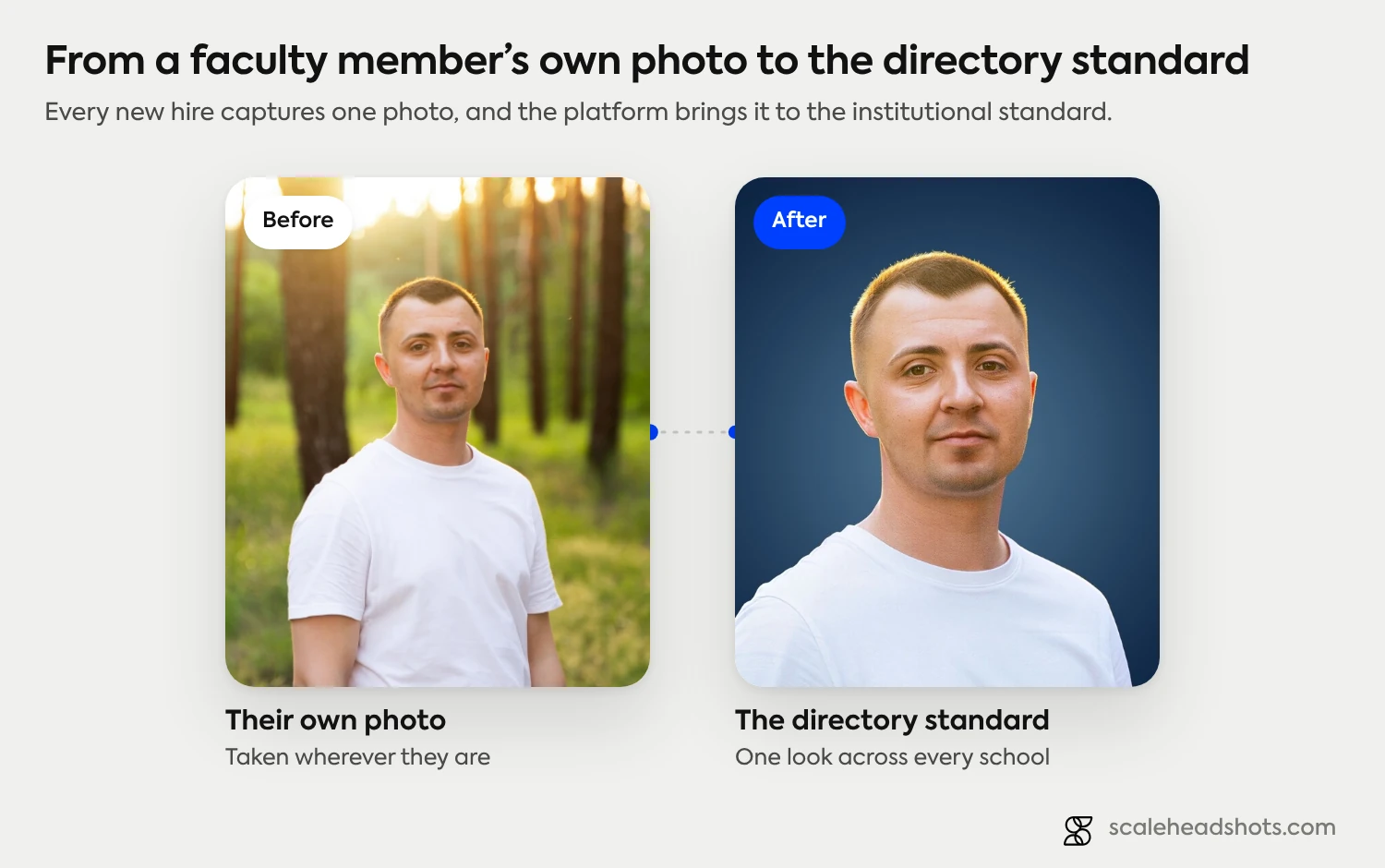
This is what Scale is built for. An administrator sets the style once to match institutional brand guidelines, then sends a link. Faculty and staff across every department and campus capture their own photo from any device, and the platform standardizes the background, lighting, color, and output so the whole institution comes back as one consistent set. Moderation and retakes keep it on-standard, and new hires run the same flow each term, so the directory never drifts back into a patchwork.
It's AI edited, not generated: the platform improves the real photo each person captured rather than inventing a synthetic face, so everyone still looks like themselves. It scales from a single department to an institution with 50,000-plus people, at a per-credit cost with volume pricing. See how the controls work on our features page, or check pricing for volume tiers.
Should every department use the same faculty headshot style?
Use the same standard, not an identical look. The background, lighting, and finish should match across the institution, because that's what makes the directory and every school's site read as one university. Attire and expression can flex by discipline: a law professor, a lab scientist, and an art historian can each look appropriate to their field while still clearly belonging to the same set. Fix the visual standard and let tone vary by department.
How do you photograph faculty across multiple campuses or remote researchers?
You skip the shoot and standardize the capture instead. Each person photographs themselves wherever they are, in their office, lab, or at home, on a phone or laptop, following the same simple guidance, and the platform normalizes the results so faculty spread across several campuses and remote researchers come back as one set. This is the only approach that scales cleanly across departments and locations at once, which is exactly the multi-campus, always-hiring situation where directories drift the most. For the capture side, our phone headshot guide covers the basics.
What teams are saying
The Scale Headshots platform is very user-friendly and the results are stellar. Setting up our customized studio was quick and easy. The platform helped us retake our employee headshots on two different campuses and allows us to maintain visual consistency as new employees join our team.
— Dessi T., Customer Success Specialist, Kansas City University
Frequently Asked Questions
How do universities keep faculty headshots consistent?
They set one institutional standard (the same background, lighting, and finish) and have faculty and staff capture against it rather than organizing campus photo days. A self-service platform lets people across every department and campus capture from any device and standardizes the results to brand guidelines, with moderation to keep the directory on-spec and new hires added to the same look each term. Attire can flex by discipline while the visual standard stays fixed.
Why does faculty headshot consistency matter for a university?
Prospective students, recruited faculty, peer institutions, and the press all judge a department partly by its website. A consistent set across faculty profiles, department pages, and the wider university site reads as one credible institution, while a patchwork of mismatched photos quietly undercuts an otherwise strong program. Consistency helps recruiting, both students and faculty, and how the institution presents itself to funders and partners.
Should every department use the same faculty headshot style?
Use the same standard, not an identical look. The background, lighting, and finish should match across the institution so the directory reads as one university, but attire and expression can flex by discipline. A law professor, a lab scientist, and an art historian can each look appropriate to their field while clearly belonging to the same set.
How do you photograph faculty across multiple campuses or remote researchers?
Skip the shoot and standardize the capture. Each person photographs themselves wherever they are, in their office, lab, or at home, on a phone or laptop, following the same guidance, and a platform normalizes the results so faculty across several campuses and remote researchers come back as one set. This scales across departments and locations at once, without coordinating calendars or booking photographers building by building.
How do you keep new faculty headshots consistent each term?
Make a headshot part of onboarding. Each new faculty or staff member captures one to the same institutional standard when they join, so they land on the directory and department page already matching everyone else. Treating it as an onboarding step keeps the directory self-maintaining: you set the standard once and every new hire is added to it instead of around it.
Where do faculty and staff headshots show up?
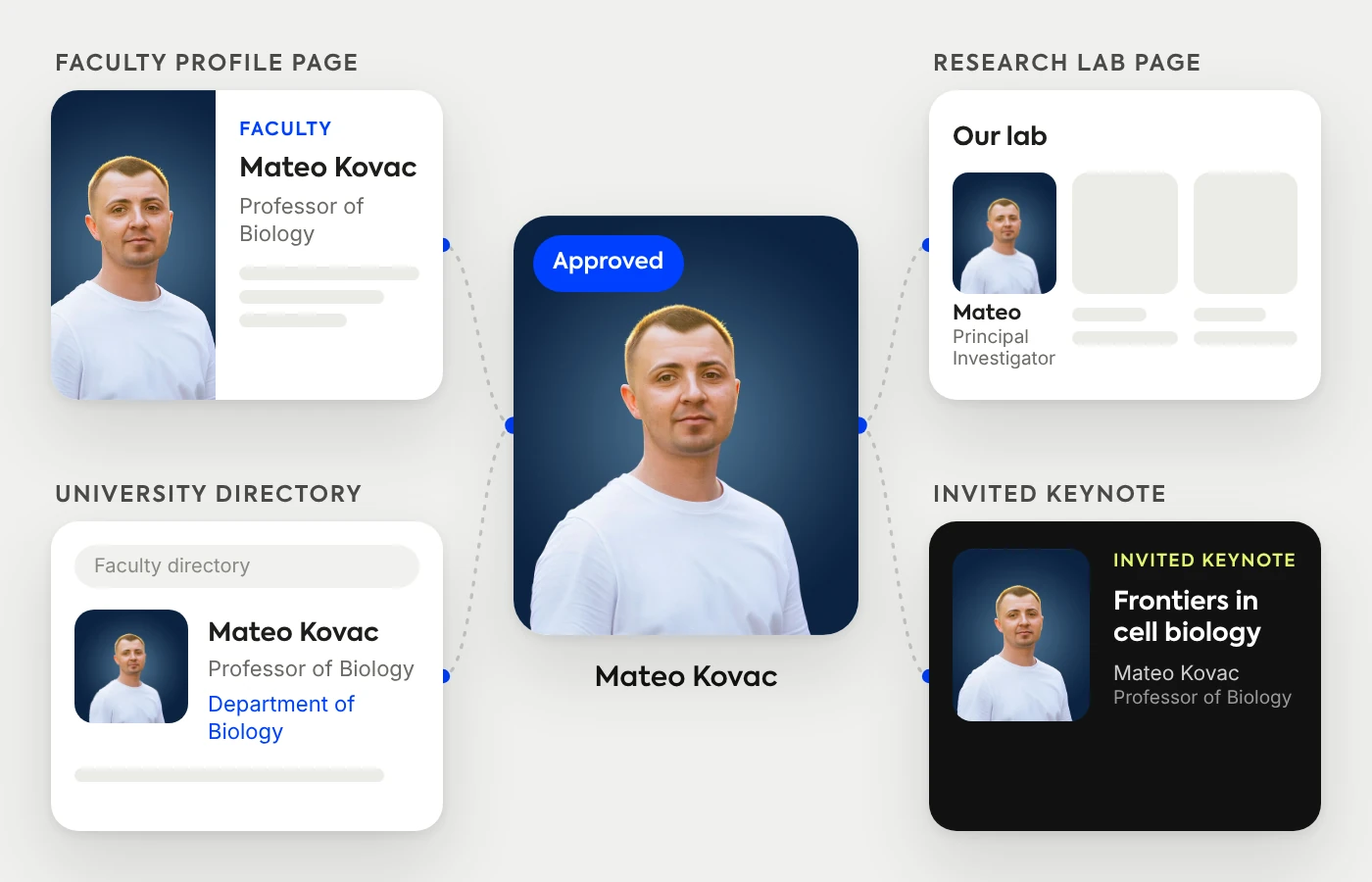
Across the institution's online presence: the faculty directory, individual faculty profile pages, department and school sites, research lab and center pages, grant and publication pages, and academic conference and speaker bios. Because these surfaces show many people together, consistency across departments is far more visible than on any single page.
How much does it cost to get headshots for an entire faculty?
Far less than campus photo days for hundreds of people. Traditional photography runs roughly $150 to $500 per person plus the logistics of coordinating departments and campuses. A self-service platform like Scale starts at $25 per headshot credit with volume pricing for large institutions and no subscriptions, and it works the same whether you're standardizing one department or an entire university.
Still have questions? Get in touch and we'll be happy to help!
One standard across every department
Set the style once to your institution's brand guidelines, send a link, and let faculty and staff across every department and campus capture against the same standard from anywhere. Scale finishes each headshot with a consistent background, balanced light, and every format you need, with new hires added to the same look each term. Real photos, AI edited, not generated. Start free with three credits.